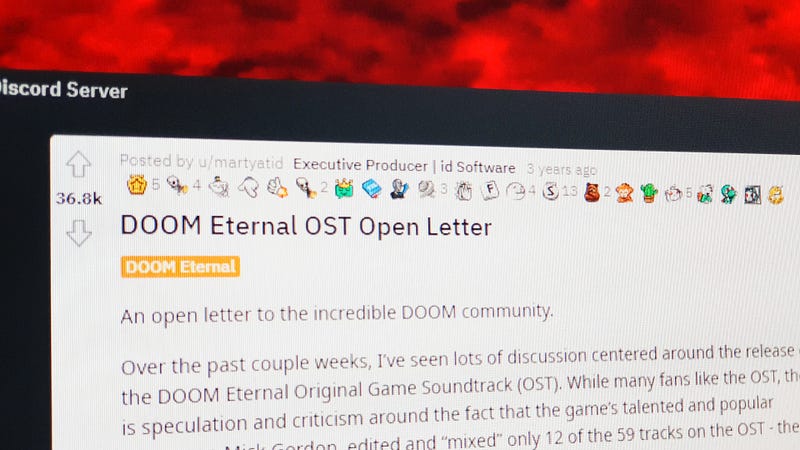
This statement is issued in response to id Software Studio Director Marty Stratton’s “DOOM Eternal OST Open Letter”, published on Reddit on May 5, 2020.
- Marty lied about the circumstances surrounding the DOOM Eternal Soundtrack and used disinformation and innuendo to blame me entirely for its failure.
Afterwards, he offered me a six-figure settlement to never speak about it. As far as I’m concerned, the truth is more important.
Marty’s Reddit post severely impacted both my professional and personal reputation. In releasing this statement, I’m exercising my right to defend myself. It is a defence, not an unprovoked attack, issued with extreme reluctance only after all other attempts to resolve the matter have failed.
This statement is not an excuse for a hate campaign. Acts of hate dished out online won’t result in any positive change. In fact, it only makes things worse.
Points of note
- My response is lengthy and detailed to prevent vague statements from turning into rumours and speculation.
- This statement is a direct response to Marty’s false accusations, and I will not name anyone outside those mentioned in his open letter.
- Privacy: To maintain the anonymity of others, I have used collective nouns such as “Management”, “id Software”, and “Bethesda” to distinguish conversations between different teams. However, collective nouns should not be interpreted as a general attack on any group as a whole. This statement does not reflect the overwhelmingly positive, successful relationships I’ve had with many people and studios under the Zenimax umbrella. The games I worked on, and the people behind them, remain dear to my heart.
- I work as a contractor. I am not a staff employee and don’t work from any client’s office. I am isolated from the development team, living and working in a country on the other side of the planet. I rarely visit studios in person, and communication is maintained through emails and calls.
- Contracts are integral. Nothing happens without a signed agreement.
- In-game score: A game’s score is written specifically for an interactive music system and consists of hundreds (sometimes thousands) of short audio files. The game’s audio system plays these files in a sequence determined by the player’s actions.
- Video game music contracts: In-game scores are budgeted in minutes. Lead developers calculate the expected length of a score at the beginning of the project and negotiate a per-minute rate with the composer, which is written into the game’s music contract. DOOM Eternal’s contracted budget was 142 minutes.
- Iteration: I rewrite the in-game score as much as necessary until the client is happy. Once they are, the client officially approves the final files, calculates the length and, deducts the minutes from the game’s overall budget, then pays me accordingly. I am not paid for any rejected music; it is discarded and not to be used.
- OST: An Official Soundtrack (the “OST”) is a separate product. The in-game score is carefully arranged into a linear album to be the most polished, best representation of the game’s score. The work is highly involved and falls under a separate contract.
Table of Contents
The game’s development
· DOOM Eternal was a difficult project · Pay Issues · The DOOM Eternal OST was announced before I was under contract · DOOM Eternal delay · I haven’t been paid for over half of DOOM Eternal’s score
The OST
· The DOOM Eternal OST · The OST was delayed before I was under contract · Making the OST · id Software’s alternative OST wasn’t up to standard. · The OST’s release
The aftermath
· Skype call with Marty after the poor release · Marty’s “Open Letter” posted on Reddit · Lawyers become involved · The purpose of this statement · Personal thoughts
Factual rebuttal
· Factual rebuttal of Marty Stratton’s claims · 1. DOOM Eternal’s OST was poorly managed from the outset · 2. The OST was delayed before I was under contract · 3. The OST contract proves Marty’s claims are false · 4. They paid me for the OST without dispute · 5. id Software had been working on the OST for six months before I was under contract · 6. Marty doesn’t seem to understand the mastering process · 7. The obvious problems immediately drew valid criticism · 8. “Doubt we’ll ever work together again” · 9. The most hurtful lie
TL,DR
DOOM Eternal was a difficult project

When I signed on, id Software handed me a music schedule that required two levels scored per month. Tight, although not impossible. But whoever dreamt up that plan did so in isolation because it quickly became apparent how disconnected it was from the game’s actual development.
Release was still two years away. The schedule, however, demanded I deliver a steady stream of final music immediately. One of the game’s key features was music that closely matched gameplay, so aiming to produce finished music for levels still months away didn’t make sense.
To have any hope of accomplishing that, I needed to rely on id Software to provide me with materials illustrating the music’s intended purpose. Difficulties emerged early on when they couldn’t provide those materials in a timely manner.
- Most levels were still getting blocked out — or didn’t exist — and the “fantasy combat puzzle” design philosophy wasn’t yet clear.
- People responsible for capturing gameplay footage were only sometimes available, and unstable builds often made recording video hopeless.
- Details on boss encounters, cutscenes, main menu design, game flow, story, lore and character arcs were still a year away.
Sticking to the schedule meant producing finished music when nobody could give me any idea what to write. I tried, but DOOM Eternal was already heading in a new direction, and my experience on DOOM (2016) wasn’t much help.
Other factors also upset the pace early on:
- A contract delay — on id Software’s side — led to a late start, putting us behind schedule immediately.
- A surprise two-week all-hands-on-deck marketing interruption took six weeks instead.
- Communication was slow, with id Software often too busy to respond to basic questions faster than a week: on a two-levels-per-month deadline, that’s a big deal.
- Conversations were bogged down with unnecessary arguments arising from unrealistic expectations, such as why the complex Metal Choir recording, which later took months to execute, couldn’t be done in the first two weeks.
Two months in, it was clear the schedule wasn’t going to work. It was a masterpiece in Excel but a disaster in reality. The requirement to write, perform, record, produce, mix, master and implement two levels of music — with feedback rounds — every 30 days, when the levels themselves were bare-bone, now looked ridiculous.
It was simply too early to attempt locking-off music.
Proposing a solution
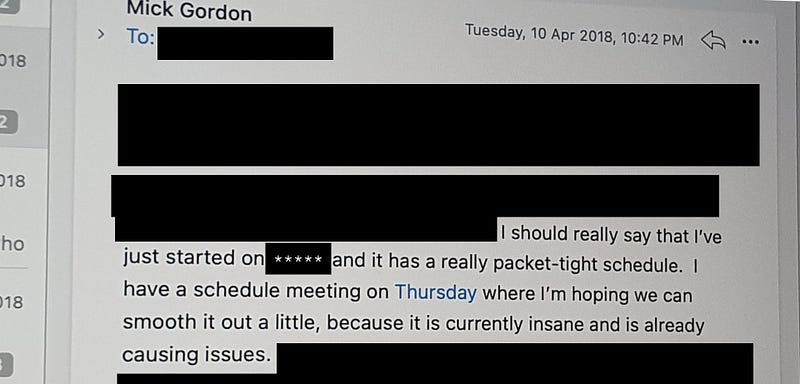 “*****” = Doom Eternal’s codename
Been here before: Coming off the back of five other Bethesda-published titles, this felt like familiar territory: most projects begin with an idealistic timetable conjured up with a crystal ball that fails to predict the unforeseeable difficulties associated with cutting-edge game development. Typically, it’s not a problem: the team adapts to the changing circumstances by adjusting the schedule and getting on with the job.
- And so, as I had done in similar situations before, I proposed a schedule change to Management.
Pointing out the issues
I clearly explained why the current plan was impractical:
- Finalising DOOM Eternal’s intricate music was practically impossible this early in development. Levels were unfinalised or non-existent, meaning the music’s context wasn’t clear.
- Guesswork was my only option, and I could see a future filled with rejections and demands for rewrites impossible to accommodate thanks to a schedule that was already packed tight.
- No time for iteration — the pace pressured the audio team to approve music, deduct minutes from the budget, and pay-out milestones before having the ability to test it thoroughly (they had already showed hesitancy to sign off on my deliveries).
- Zero wiggle room. Any slip meant milestones would bleed into one another, requiring crunch to catch up.
Problems had already arisen from the failure to consider how unstable builds, video capture delays, slow communication, marketing interruptions and unclear direction would affect the schedule. And no allowance was made for other time-occupying factors, such as team leads taking leave, holiday periods, need for rest, or illness.
Solution:
I proposed an alternative plan that reflected the reality of development instead.
- My plan mirrored a typical approach: first define the overall game’s musical identity by writing strong reusable themes before ramping up production of final music assets when the game’s exact needs become apparent.
- Key dates stayed precisely the same, including the all-important finishing date, but the immediate pressure of locking off two levels of music per month was eliminated, which had caused headaches already.
It was early in development and the perfect time to make the change. My proposal was easy to execute, fit the development schedule and budget, and would facilitate an overall better result. I was confident Management would see the benefits and adopt the plan.
I was wrong.
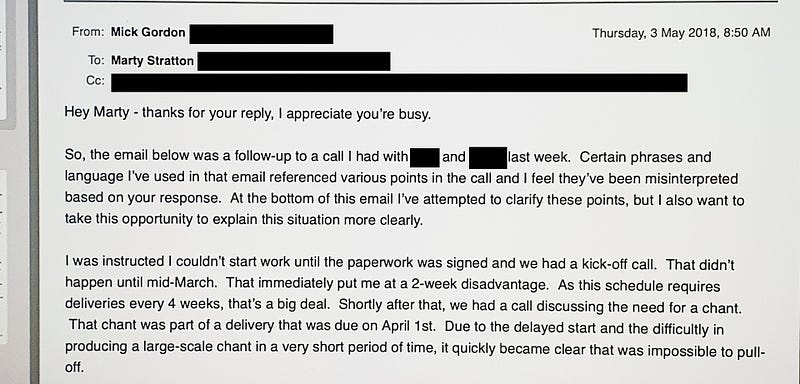
Marty struck it down
He rejected my belief that the current schedule was flawed and suggested my act of trying to do something about it was a sign of incompetence. Refusing to accept the reality of the situation, he threw the proposal back in my face and proceeded to tear me down for having the audacity to raise the issue in the first place.
- I was taken aback by his reaction. In response, I said he seemed to misinterpret my proposal’s intent, that the current schedule’s rigidity would cause issues down the line, and that finding an execution framework for achieving our ambitious goals was my only agenda.
He didn’t reply, but the blow-up made it abundantly clear that the schedule would not change: I was stuck with it. I was already pulling all-nighters two months in, and I still had 18 months to go.
Pushing forward
id Software’s management had convinced themselves that locking music early would be a time-saving strategy, but it was a nightmare in real life. The team struggled to clearly communicate the musical requirements within the timeframe set by the schedule, which was understandable since some levels were still a year away.
- I tried my best, taking inspiration from blockout videos, concept art and text, but ultimately I resorted to imagination to score levels from the future I couldn’t yet see.
Unsurprisingly: The game taking shape months later inevitably proved my guesswork compositions didn’t fit. Weeks of work got thrown in the trash, and calls for urgent rewrites came amid milestones already packed tight.
- The project’s demands began to pile up, throwing the schedule into disarray.
What frustrated me beyond belief was that I had flagged these exact issues as potential problems earlier in the project. But Management seemed to forget that and instead blamed the causes on me. Immediate team members were sympathetic to the circumstances, but looking to them for support rarely got me anywhere. They were usually reticent, unsure of themselves and hesitant to raise issues with upper management.
 Rewrites began early in the project
Blowouts: As development progressed, it became obvious whoever thought up the music budget also had no idea about the game’s true scope. Stages blew out in size far beyond what had been anticipated.
- Hour-long levels where players traverse fantastic worlds with epic vistas and tricky platforming sections had just 30 seconds allocated to exploration music.
- DOOM’s mantra is wall-to-wall music, which made this oversight seem laughable.
I was able to convince id Software to dedicate more minutes to these areas, but only after wasting valuable time on unnecessary demonstrations to prove that 30 seconds wasn’t nearly enough. To compensate for the shortfall, they didn’t unlock any more budget: instead, they reallocated minutes from the game’s combat music pool, meaning other areas had less music as a result.
Overwhelming: I worked straight for months, desperately trying to stay on top of things, and each week seemed to bring a new set of problems.
- I was cut out of music meetings, my emails went unanswered, and the mandated file transfer system auto-deleted all the music files every two weeks. id Software withheld important information, and I was hardly ever able to check my music in-game.
Weekly calls with the audio team, which I relied on as a source for crucial creative information to do the job, were frequently hijacked by panic-stricken managers, who seldom bought anything helpful to the table and instead just hiked up stress levels.
- The heaping list of problems and their accumulative effect on the schedule didn’t seem to matter to those people whose only method of response was messages laced with criticism.
More crunch, less sleep.
Pay Issues
 After working eight months without pay, I was paid in January 2019, but after that I wasn’t paid again for 11 months.
Pay issues: Arguments over pay began when id Software threw out two entire suites written for Super Gore Nest and Mars Core shortly after the QuakeCon 2018 premiere. The rejection was bad enough — it meant scoring four levels simultaneously the following month — but id Software also denied payment on the notion they changed their mind and no longer liked the music. I argued music appearing at a promotional event constituted usage; therefore, they owed me compensation. In this case, they caved.
But as development continued, they grew reluctant to approve anything I delivered.
- As predicted, the audio team weren’t willing to sign off on anything they couldn’t thoroughly test.
- They withheld approvals — and therefore payment — for months. Beginning in January 2019, I went 11 months without pay.
Uncertainty: Delaying approvals also kept the official measure of completion in a constant state of ambiguity. I kept writing and writing, delivering suite after suite, working as hard as possible. Yet, Management constantly painted my progress as a total failure and, therefore, an opportunity to chew me out with scorn and ridicule. Not wanting to discuss the circumstances (like how lack of materials was still an issue…), these individuals would seldom offer assistance or put forward any solutions. Instead, they just sullied the relationship with unnecessary layers of friction.
Crunch: Blowouts, rejections, lack of approvals, endless demands, marketing disruptions and ambiguity over the actual state of progress translated to one thing: severe crunch. For a year now, I had been sleeping in the studio away from home, surviving on microwaved food and spending long periods away from family.
But then things got worse.
The DOOM Eternal soundtrack announcement
 I wasn’t aware of the DOOM Eternal soundtrack prior to the E3 announcement.
During Bethesda’s E3 Showcase on June 6, 2019, Marty announced: “DOOM Eternal will release on November 22nd”.
- A special Collectors Edition was also announced, which included “Mick Gordon’s original DOOM Eternal soundtrack” (The OST):
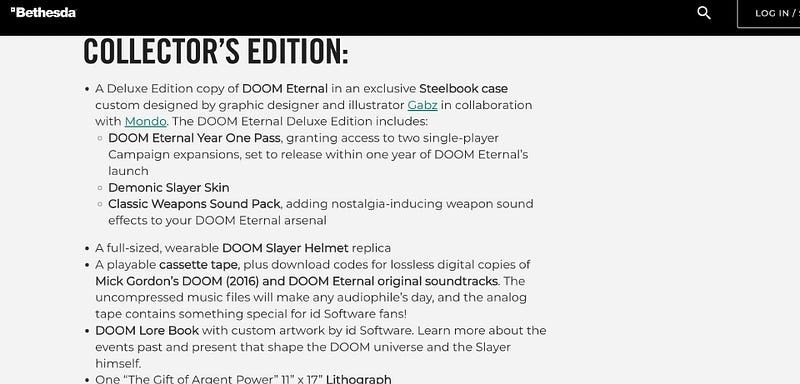 At the time of the announcement, I wasn’t under contract to produce the OST
The problem: Pre-orders went on sale immediately, a severe issue because customers were putting money down for a Collector’s Edition item that had no way of materialising.
- The standalone OST wasn’t in production, and I hadn’t been offered a contract to produce it. In fact, we hadn’t talked about the scope, the timeframe, or whether it was even feasible.
- E3 events are planned months in advance, well-rehearsed, and carefully managed, but nobody thought to discuss the OST with me in any way whatsoever. I learned about it in the media.
I sent an urgent message to id Software, saying they had put me in a difficult position and we needed an agreement immediately to ensure customers would get their product.
But there was no OST strategy
Marty’s response threw me. For reasons I still don’t understand, he flatly denied me the contract and refused to do anything about the OST, saying he didn’t want to cause a “distraction”.
- Didn’t want to cause a distraction? Didn’t they just announce it at E3, the largest gaming show of the year? Couldn’t they see the issue of taking pre-orders on a product without any agreement or strategy to actually deliver it?
I pushed the issue again, but Marty refused to be drawn into an argument and shut the conversation down. He also didn’t leave me with any alternative plan: clearly, there wasn’t one. Pre-orders sold out in days.
The reality: Marty has since publicly repeated this “didn’t want a distraction” notion, but the truth is it caused a giant distraction.
- The Collectors Edition, a premium product sold for hundreds of dollars, was advertised with the expectation that buyers would receive a copy of “Mick Gordon’s original DOOM Eternal Soundtrack”. But without a contract to actually produce the OST, there would be no OST to include.
- I was now under enormous pressure: attaching my name to it meant I’d be held publicly accountable if it failed.
- Nobody involved in the announcement seemed to consider consumer protection laws. Promising a product that wasn’t in production put id Software/Bethesda at risk of violating those laws — an oversight that would have severe consequences in the months ahead.
Marty reckons he didn’t want a distraction. What exactly wasn’t a distraction about this situation?
Finishing the game
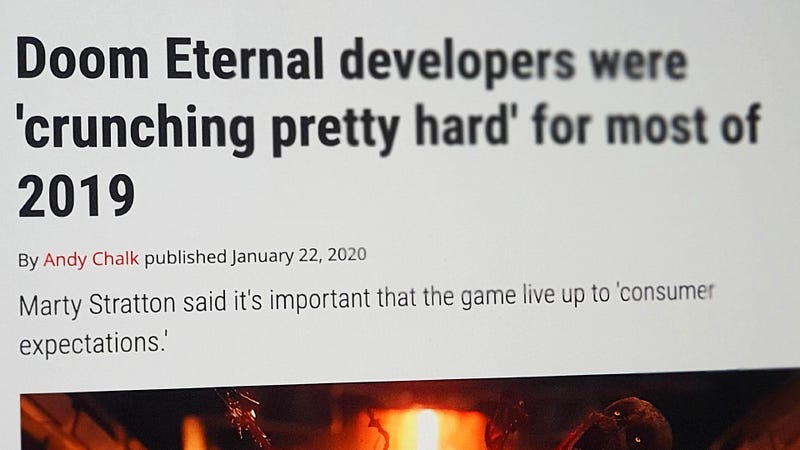
In the following months, I continued to stress severe concerns regarding the apparent lack of any OST strategy. But time and time again, I was either dismissed or outright ignored. Marty’s position made no sense to me, and I determined that id Software was stretched thin by the overwhelming push to make the November 22 release date and had no capacity to deal with other problems looming.
Development wore on: Tensions between id Software and me had been undeniably building from the beginning and only worsened as the cycle of demanding music, avoiding approvals and withholding pay continued.
- Payment enquiries were routinely met with either empty promises, deflections, or long-winded excuses, while they prioritised requests for new music over signing off on previously completed suites.
- Whenever I put forward the belief that perhaps the game had enough coverage and the minute allocation had surely been exhausted, they’d reject older music to make room for new demands.
- Occasionally, I bore the brunt of some managers adopting Bethesda’s legal history as clout to make lawsuit threats during arguments over demands.
I contemplated quitting, except keeping up with the demands whilst not being paid meant I had financed the score expenses out of my own pocket. I found myself in a commitment bias, worried I’d lose more by walking away than I’d gain by staying. So, I kept working.
By the time we hit October, I still hadn’t received all the materials needed to finish the score; they hadn’t paid me since January and still refused to talk about the OST.
DOOM Eternal delay
 DOOM Eternal delay announcement came via Twitter
Suddenly, just six weeks from the release date, DOOM Eternal got delayed into the following year. The new release date, March 20, 2020, was five months away.
- Delaying the game was the right call: at the time, it was not polished nor optimised, and Bethesda didn’t want a repeat of Fallout 76.

Shortly afterwards, id Software rejected more of my previous work, arguing they needed to claw back minutes to cover new requests for late changes and additions to the game.
The mood turned sour: The ever-increasing demands for work coupled with ongoing crunch and lack of pay had taken a significant toll on my family and me. I pushed back on the demand, telling them I couldn’t continue to work without pay. I hadn’t been paid anything in 10 months — no more rewrites, no more excuses, no more discussions: I needed to be paid now.
- But no. According to them, I was the one being difficult (the word they used was “ball-ache”), and they urged in no uncertain terms to carefully consider the destination my protest would lead to.
My financial situation was dire — this project had been my only source of income, and I couldn’t afford to enter a dispute against the Zenimax legal machine over money. Facing the possibility of not being paid for the past 10 months at all, I relented and carried out their final demands.
Done
The money finally turned up at the end of November, and my family and I were thankful it did. It was the first payment I’d received in 11 months. id Software stopped talking to me, but the payment confirmed my role in the project had ended.
I finished the project feeling unhappy, empty and in a state of anxiety. I crunched for two years straight thanks to a rigid, brutal music schedule that attempted to finalise the score before the game was ready for it.
- Forcibly writing music without a clear purpose caused problems when id Software inevitably rejected it months later, throwing it out with the unrealistic expectation that urgent demands for rewrites somehow wouldn’t impact the already crunched schedule.
- I understand this approach was supposedly intended to elicit an efficient performance. But in reality, it was spectacularly inefficient: by the end of the project, I’d delivered more than double the minutes stated in the contract.
Pay disputes, project uncertainty, and an overly chaotic atmosphere compounded the stress. And the whole situation was made worse by disciplinarians who treated unavoidable problems as incompetent failures worthy of reprimand.
Still, I stuck with id Software every step of the way, determined to get the job done. We ultimately achieved everything we set out to accomplish in a reasonable timeframe, and DOOM Eternal went on to release to critical acclaim and commercial success.
Still no OST deal
With the in-game score out of the way, Marty had no excuse for holding me back from the OST, and I raised the issue again. I tried to appeal to reason, concluding that if I began work immediately, I would have equal time to produce the DOOM Eternal OST as I did the DOOM (2016) OST.
I didn’t receive a reply.
id Software went on to use nearly all the music; over double what they paid for.
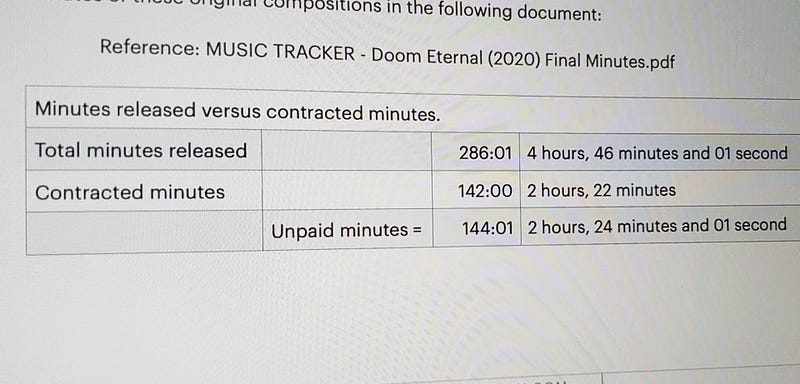 id Software still hasn’t paid me for half the score
It wasn’t until after DOOM Eternal was released that I became aware id Software had used nearly all the music I produced throughout development — almost five hours worth — while only paying for half of it.
Isolated from the team, working on the other side of the planet, I had no control over how they used the music: music placement was the Lead Audio Designer’s responsibility, and after I handed the files over, they decided how to use them.
- Using double what they paid for wasn’t an accident; it was a conscious decision.
Rejected tracks, mockups, demos, ideas and sketches — a massive amount of additional music, well beyond the budget allocated in the contract, produced at their request and shared in good faith. But, id Software included it all directly in-game, marketing, and updates without paying for it.
Even worse, id Software still refuses to pay for it, despite the fact their contract guarantees payment for any additional minute requested beyond the original budget.
- Clearly, the cycle of demanding and rejecting music, avoiding approvals and withholding pay was a strategy to elicit enormous amounts of unpaid work to compensate for their budgeting shortfalls.
But I wouldn’t find that out until much later.
The DOOM Eternal OST
 At the start of 2020, there still wasn’t an OST deal, even though pre-orders had been on sale for six months.
Desperation
The beginning of 2020 marked six months of pre-order sales without an OST deal. My sustained demands for a contract had become an arduous exercise in expressing myself to deaf ears. id Software had gone silent, and I hadn’t heard from them since November. The release date was fast approaching, alarmingly so, and I was infuriated by the fact that I had been made publicly accountable for this item while being blocked from actually doing the work. Fan expectations for a worthy follow-up to the DOOM (2016) OST were resting heavily on my shoulders, and I did not want the OST to be a catalyst for another botched pre-order story.
Something needed to be done.
- All previous attempts to engage id Software regarding the OST were either shut down or outright ignored. Reaching out to them again would be a total waste of time.
- I decided to circumvent the stonewall by going above Marty Stratton, outside of id Software and directly to Bethesda to report my concerns and request an OST contract.
I was worried that approaching Bethesda directly might ruffle some feathers at id Software, but I hoped they would see the seriousness of the issue and that it needed to be acted upon immediately.
On the morning of January 8, I emailed Bethesda:
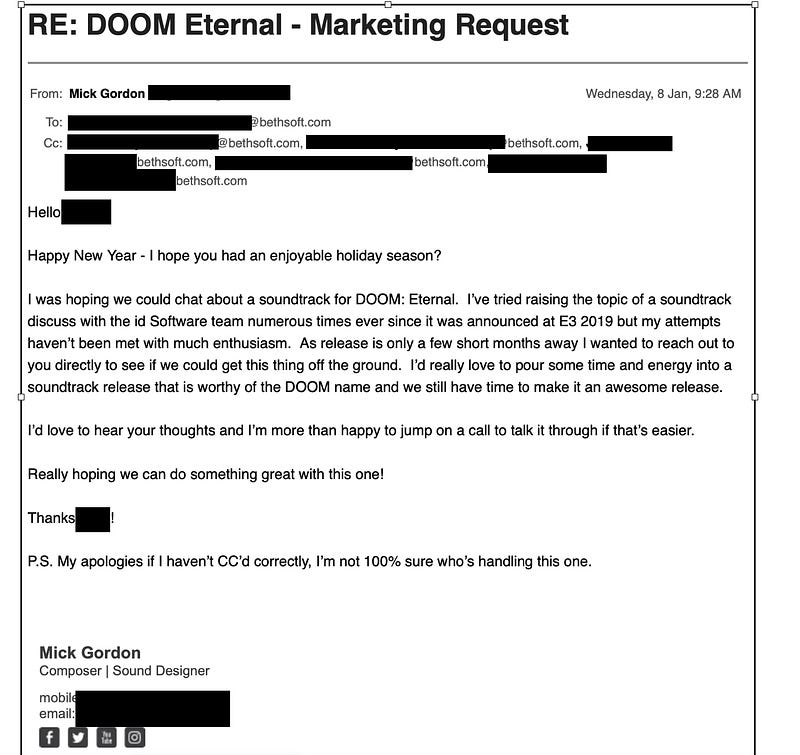 After getting nowhere with id Software, I took my concerns to Bethesda directly
Bethesda quickly responded: they were grateful to make contact and told me they would love to talk about the OST. I was excited to see the wheels finally start to turn. I also noticed that neither Marty Stratton nor anyone from id Software had been included on the email thread.
- That continued to be the case over the following weeks — I discussed the specifics of the OST project and negotiated the deal directly with Bethesda without any involvement from Marty Stratton or id Software.
But we had an unresolved problem with another soundtrack
Back in 2015, I scored another Bethesda-published game from a different studio. Shortly before release, the team asked me to produce a stand-alone soundtrack album and wanted it ready for day one. The whole thing felt very last minute, but I agreed to do it.
Rush: I started working immediately, but they held up the contract, saying their sluggish legal department was so behind schedule that the agreement wouldn’t be ready until after I delivered.
- That was far from ideal, but their assurances led me to trust the contract would come through after delivery.
That was my mistake.
I crunched to finish it on time, but when handing over the finished album, the team abruptly told me they no longer planned to release it. There was no use for it, and, as such, they refused to pay for it. The contract never showed up.
- It was hard not to get mad. But upon reflection, I had to accept it was my fault for working without a signed deal in the first place. I learned a valuable lesson: don’t ever work without a contract.
Four years later: In October 2019, Bethesda suddenly began selling that very same album, without telling me beforehand — I learned about it through social media.
- Worse yet, they hadn’t paid for it.
I sent a demand, and Bethesda agreed to pay for the album but insisted the payment be consolidated into the DOOM Eternal OST contract.
DOOM Eternal OST contract negotiations with Bethesda
Deciding on the content of DOOM Eternal’s OST was a crucial detail that needed to be written into the contract. I initially wanted the album to be similar in scope to my DOOM (2016) OST. I proposed a comprehensive album of 30 tracks and a runtime of over two hours.
- Marty would later claim this was the agreed deal, but that is entirely false. In fact, the suggestion was shot down within a matter of hours because it was evident to me and everyone else actually involved in the discussions that there simply wasn’t enough time or budget to make it work.
12 songs: Instead, with the imminent release date rapidly approaching, the reality of the situation dictated the scope: Bethesda asked me to produce 12 songs, and I felt that was doable in the short timeframe we had.
On March 7, two weeks before the game’s release, Bethesda sent me draft terms for my review. The terms stated:
- I would produce 12 songs for inclusion in the OST;
- All 12 songs were to be selected by id Software;
- id Software had final approval;
- I was required to hand over all my source files, such as stems, raw assets, mix sessions, etc.;
- The deadline was April 16.
Bethesda told me that the April 16 deadline was ideal, but if I needed more time, they would be happy to amend the contract later. The deadline was therefore considered flexible, but as an incentive, they offered a bonus if I finished by April 16.
- They also assured me the contract would include payment for the other OST I produced in 2015.
The OST was delayed before I had a contract
 On March 11, Betheda announced a delay to the DOOM Eternal OST. I still didn’t have a contract.
On March 11, Bethesda publicly announced the album wouldn’t be out on March 20, as promised. No new release date was given because there wasn’t one: I still hadn’t received the contract.
Zenimax sent me the agreement on March 18, just 48 hours before the game’s release.
- Marty would later claim the agreement was finalised in “January”, implying I was under contract for much longer period. That is a lie. As proof, this is a screenshot of the actual contract email showing the exact date:
 I received the DOOM Eternal OST contract on March 18, 48 hours before the original release date.
29 days: Despite the stress arising from the last-minute OST deal, I felt the contract terms were doable: 12 songs by April 16 (29 days away). Although I was disappointed by the overall situation and limited scope, I couldn’t see any obvious warning signs that things would derail so terribly. I agreed to the terms, and all parties signed the contract within hours. I readied myself for four weeks of solid work. Two days later, DOOM Eternal was released.
Making the OST

Even though the contract was now underway, I hadn’t actually received any direction from id Software regarding the OST, and they continued to make no effort to talk to me about their expectations. But rather than waste time waiting, I took the initiative to begin work on what I thought would make the best album.
Initially, production went smoothly, and I finished half the album after two weeks. But then, on April 3, thirteen days before the OST was due, I received an email from Marty Stratton.
Marty gets involved, bringing threats, contradiction and panic

Marty’s email stated, contrary to what Bethesda had told me, that the April 16 date was now an absolute necessity. He said consumer protection laws in some territories meant anyone who purchased the Collector’s Edition was entitled to a full refund if they didn’t receive the OST by April 20.
- It dawned on me that I was being threatened: refunds meant financial losses. Marty was saying, in his view, I was legally liable for any loss id Software suffered due to customers claiming refunds over a late OST — if it wasn’t ready in thirteen days, they would come after me.
- I did the numbers in my head, and the thought was terrifying. I couldn’t understand why Marty hadn’t told me sooner. If I had been made aware of the consumer protection issue before signing the contract, I would have refused to do the OST.
The fact that this critical piece of information had been withheld from me until after I’d signed the contract made the whole thing feel like a setup to shift liability caused by selling the OST without a contract in the first place.
id Software had been working on an alternative OST, without me, for at least six-months.
Marty then revealed he had previously instructed Lead Audio Designer Chad Mossholder to make an alternative OST by cutting together songs using edited chunks of my in-game score.
I responded to Marty, expressing my regret at the situation and my belief that working against each other didn’t make any sense, especially under the circumstances.
- I said we should pool our resources and work together toward a better outcome.
He didn’t respond. Instead, Chad contacted me four days later and said his album of edits was almost complete. I asked to hear it. To my surprise, Chad sent me seventy-plus tracks. And it was clear he had been working on it for some time.
- In his “Open Letter” posted on Reddit, Marty later claimed that his decision to enlist Chad happened at the last minute and was due to fears I wouldn’t make the April 16 deadline. But the files Chad sent me tell a different story.
- Perhaps unknown to Marty, BWF Metadata details the exact creation date, time and software used by whoever made the edits. Metadata in Chad’s files show he began work on their alternative OST as far back as August 2019 (six months before I received the OST contract):
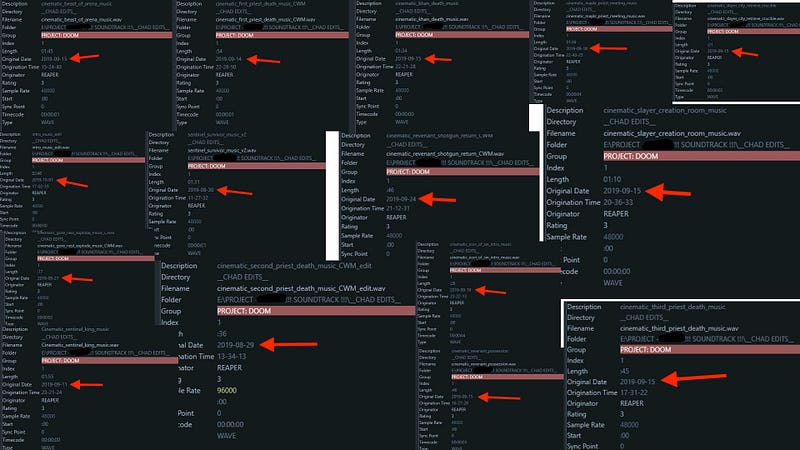 Origin dates found in BWF Metadata of Chad’s alternative OST files, showing he had begun editing these using Reaper (Chad’s DAW of choice and not a DAW I use) at least six-month before I had the OST contract.
DOOM Eternal was originally planned to release on November 22, 2019. Chad must have begun work on the OST in August to avoid the same consumer protection issues. At that time, I didn’t even have a whiff of an OST contract.
id Software’s alternative OST wasn’t up to standard.
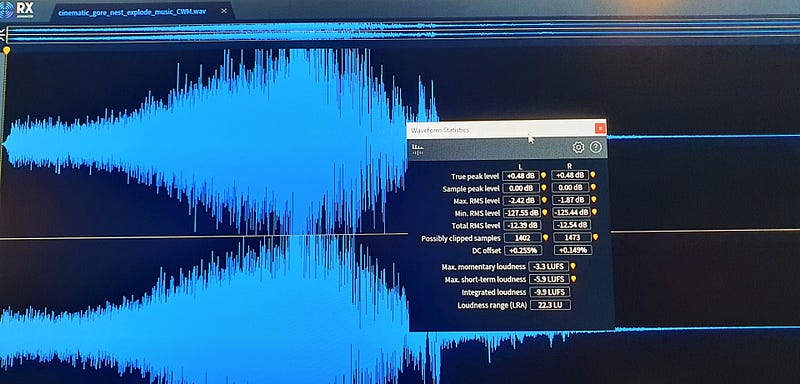
I hoped to use Chad’s edits to expand the album beyond the limited 12-song contract. But unfortunately, the content fell far short of expectations. It was a mess.
- The edits had been eyeballed in a slapdash way by copying audio files directly on top of each other without even a crossfade to cover the transition, resulting in clicks, pops, clipping, abrupt tempo changes, awkward gaps and jarring transitions.
- Some “songs” were just seamless loop files ripped directly from the game’s Wwise package.
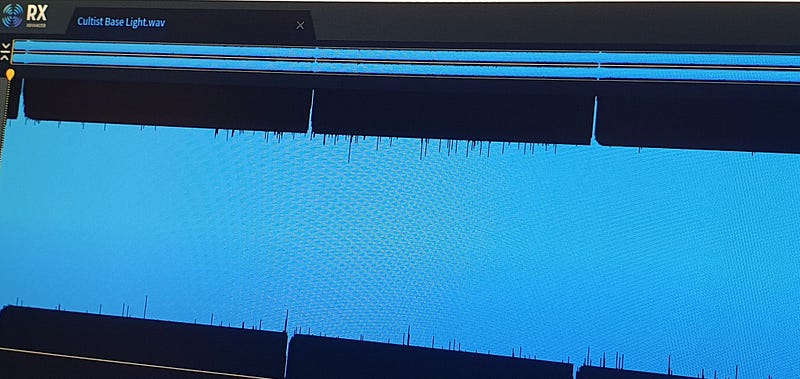
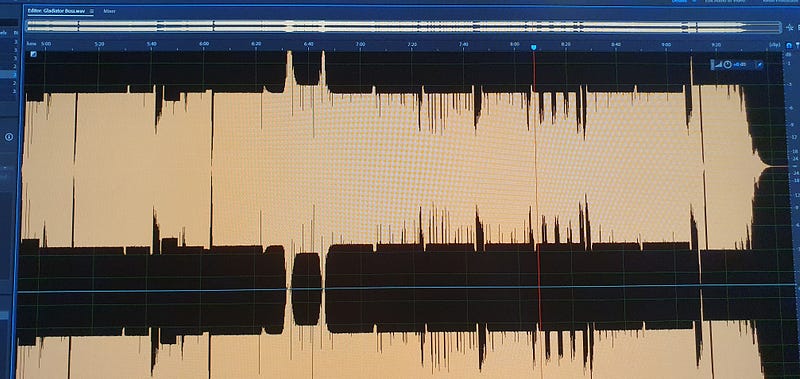
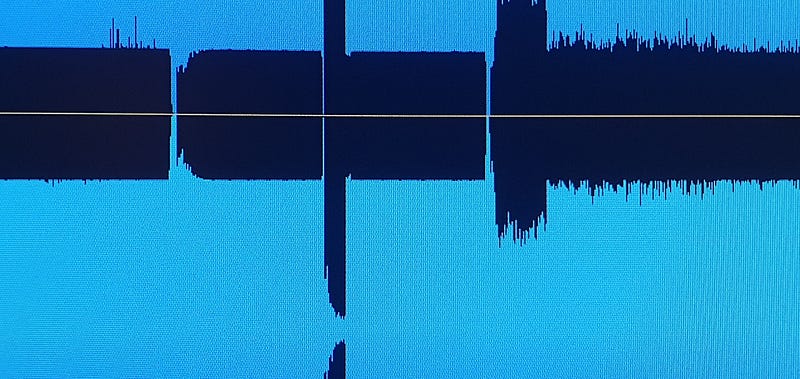 Clicks, pops, clipping, abrupt tempo changes, awkward gaps and jarring transitions — Chad’s edits didn’t even have crossfade covering transition points.
Not good enough: Chad’s edits largely disregarded basic music fundamentals, and there was no way it would live up to consumer expectations.
- Marty would later dismiss these legitimate issues and palm me off for drawing attention to them by minimising my position to an “artist’s perspective”. But he hired me to ensure DOOM Eternal had the best music possible, and Chad’s edited versions simply weren’t up to the franchise’s standard.
The final days
The deadline was imminent: 8 days away. I did not have the time or budget to address the many problems in Chad’s edits. I had to face the reality of the situation, pivot away from creating the best possible album, and do everything I could to avoid the repercussions Marty had threatened earlier. The only way to achieve this with certainty was to stick precisely to my contractual obligations. I reminded Marty my responsibility only extended as far as 12 songs and that finishing them would be my focus for the remaining eight days.
It was Easter weekend. But instead of family time, I crunched 18–20 hour days and slept under my desk. Late Tuesday night, I sent the following email to Bethesda, asking to confirm the deadline:
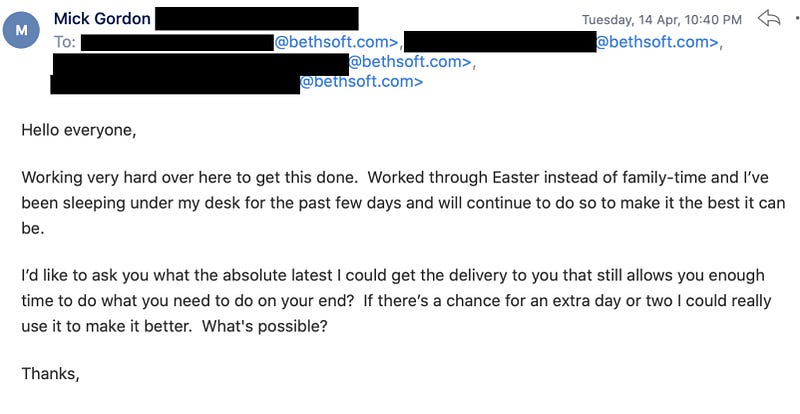
They emphasised April 16 was an absolute necessity. I barely slept for the next two days, focusing intensely on that date.
The final hours
The deadline arrived, and despite being worn down from the combined effects of overwork and lack of sleep, production had gone well. But on the final day, I encountered a system-related technical problem, and I contacted Bethesda to explain the situation:
- I had ten songs ready for handover, but a computer issue had halted progress. I needed 4–5 hours to fix it and bounce the final tracks.
Bethesda was understanding and granted the minor extension.
However, Marty wasn’t happy. He demanded an urgent group call across three different timezones to tell everyone he didn’t want these ten songs. He actually wanted other songs.
I couldn’t believe it. The deadline was five hours away. I had been awake for days after working four solid weeks. Ten months had passed since the OST first went up for pre-order. However, despite ample time, Marty hadn’t given me any direction on the OST whatsoever. But now, at the absolute last possible minute, he actually wanted to do something about it.
I shot back that their rapidly crunching schedule and imminent deadline meant it was too late for a change in direction and that I’d prefer to use the little time remaining to work on the music rather than entertain his sudden last-minute interest in the OST.
He responded by taking over.
He said they would release Chad’s version instead. He told me to hand over my tracks, and Chad would assemble the final OST.
- I could have protested, but it wouldn’t have done any good. Under the contract, Marty was guaranteed veto power and complete creative control. Ultimately, I’m just a contractor — it’s their product, and they govern every aspect.
- I voiced my anxieties over Chad’s edits and hoped they had improved since the week before. I said they should ensure the album adheres to mastering standards and provided specific details in that regard.
I handed over my tracks and wished them as well as I politely could. They approved my tracks and confirmed I had met my contractual obligations. The total contract amount, including the on-time bonus payment, was later paid-out in full without dispute.
I never heard the final version
The final album, and its details, were withheld from me, and I wasn’t allowed to hear it before release. All I had to go on was an email from Marty saying he thought their version had turned out well and fans would be pleased.
I was done. Not just with the OST but with id Software too. I struggled to understand why a challenging two-year development had ended with an unnecessarily difficult fortnight.
- I was extremely nervous about the release and felt that fans, ignorant of the situation behind the scenes, would likely criticise the outcome.
Deterioration: Depressed and totally exhausted, I felt dragged down into futility after not having slept much in weeks. But even more seriously, I was just now becoming aware, through game-ripped music popping up online, of the sheer amount of unpaid music used in DOOM Eternal. I just wanted to crash, but the situation was about to get worse.
The OST’s release

id Software announced the release of the OST with a tweet. It said Collector’s Edition owners could download it immediately, and it would be available on streaming services “in the coming weeks” (over two years later, that still hasn’t happened).
Utter shock: hearing the album for the first time, my heart sank. Alongside my direct contributions were an additional 47 tracks made by poorly editing together bits and pieces taken from my in-game score. They exhibited the same thoughtless disregard for basic music fundamentals that plagued the preliminary edits id Software showed me a week earlier.
But in some cases, they’d actually been made worse.
- The majority had been made by stitching together multiple audio files without even a crossfade to cover the edit point, resulting in hard cuts, volume spikes and digital clipping.
- Many of these splice points were made free-hand, off-grid, leading to awkward transitions and abrupt tempo changes.
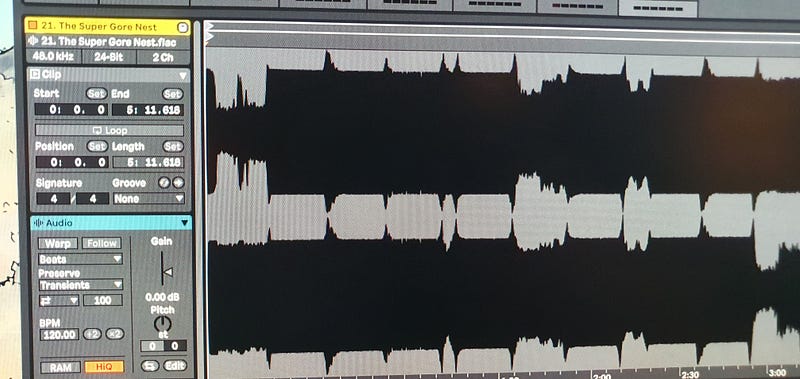

 The same thoughtless disregard for basic music fundamentals that plagued the preliminary edits ended up on the final OST.
I was stunned at the ineptitude and couldn’t believe what I was hearing. Track after track was full of real, obvious technical faults, mistakes, and errors resulting from careless editing.
Example: One of the most successful songs from my DOOM 2016 score, BFG Division, barely makes an appearance in DOOM Eternal. But for some reason, the song was butchered to make three tracks for the DOOM Eternal OST.
- Track 24, “You Can’t Just Shoot A Hole Into The surface of Mars” [sic], starts with two separate sections playing directly on top of each other, but they’re out of sync. The track soon falls apart with a series of stunningly shoddy edits, completely out-of-time, until the main BFG Division riff makes a sudden 8-bar appearance before the track ends abruptly.
Why this was included is beyond me.
There’s no excuse for these crappy edits: I deliver my music in a neatly packaged Wwise file complete with tempo information and carefully crafted transitions designed to seamlessly react to the player’s actions, something many reviewers mentioned.
- id Software would have had more success if they’d simply recorded the Wwise output. The fact that so many YouTubers have been able to construct far better representations of the DOOM Eternal score using this exact method proves the point.
Credits: seeing Chad credited as co-artist on these tracks pissed me off. Credit theft (the act of taking credit for someone else’s work) is rampant in video game music. Chad didn’t write, arrange, perform, record or produce any of this music.
- He carried out a copy-paste job, cutting apart finished music and resaving it. For this, the proper credit would be considered Music Editor. Yet, in some cases, such as Urdak (Track 8) and Deag Ranak (Track 15), he did nothing but change the filename.
That frustrated me immensely. I crunched for two years straight on my DOOM Eternal score, and the fact that someone else thought it proper to take the credit for my work felt like a cruel insult.
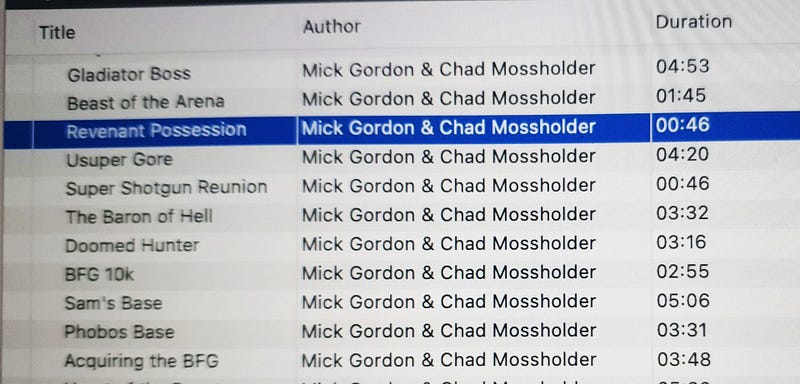 Chad didn’t write, arrange, perform, record or produce any of this music.
Worst of all is the inclusion of hours of music and rejected demos I was not (and still have not been) paid to produce.
Example: Final Sin — Sandy City (Track 59) was a rough idea mocked up in haste for the ending cutscene.
- This exact demo file was immediately rejected. In fact, Chad was part of the panel that rejected it. But he included the file on the album and listed himself as a co-artist, despite having absolutely nothing to do with it.
- More importantly, the song is based on a melody written by Bobby Prince, the composer of DOOM 2, who hasn’t been credited anywhere on the album.
id Software never paid me for this demo, which was produced in good faith and not meant for public release.
I was dismayed
Instead of a worthy follow-up to the DOOM 2016 OST, the DOOM Eternal OST had been reduced to a cheaply thrown-together cash grab. The album was a disgrace. I worked extremely hard on the music of DOOM Eternal and crunched for years to make it happen. To have it presented in such a lousy way was heartbreaking.
But ultimately, its fans who spent hundreds of dollars on the Collectors Edition who should be the most disappointed. Marketing lured them under the false pretence that they were getting an OST from me, but instead, they got served a haphazard mess cobbled together by someone else. The OST itself, the factors that led to it, and the extensive use of unpaid music both on the album and in the game meant I could not publicly support id Software with any shred of honesty.
Skype call with Marty after the poor release
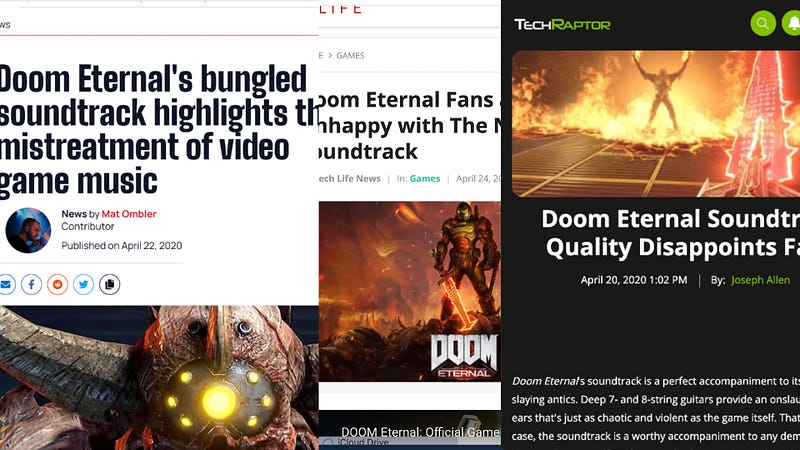 The poor quality release immediately drew criticism
Marty demanded a call
The OST’s problems were glaringly obvious and immediately drew negative criticism.
Within hours of the release, Marty emailed me. He was frustrated at my lack of public support and deeply concerned the OST was attracting bad press. He insisted we urgently address the OST situation publicly through a joint statement that affirmed our commitment to doing something about it.
He asked for a call to discuss the matter.
I was skeptical of his intentions. Marty can overwhelm you with the power of his disappointment. I was worried he was setting up the call for confrontation, not resolution.
- My responsibility to him ended when my contract finished, and I didn’t feel like committing myself to a barrage of threats and abuse.
- In my view, the poor reception was the real-world consequence of a mismanaged project.
Marty reassured me a positive outcome was his only focus. He insisted he had no intention of doing anything to disparage me or my work and only wanted to overcome the situation with a professional and collaborative approach.
After considering his demeanour, I felt I should embrace the opportunity to engage Marty directly on the OST and unpaid minutes because I also wanted a positive outcome to the situation.
- Marty reassured me and said that he genuinely wanted to work together. That’s what’s “best for all”, he said.
- I had no reason to suspect he had anything but positive intentions, so I took him at his word and agreed to take the call.
Skype call with Marty

Straight away, it was clear Marty was angry with me. “Frankly, we’re too fucking nice”, he snapped.
I approached the call like one should when dealing with a manager on the warpath: keep calm, listen intently, and express understanding but remain firm. I was upset my music had been butchered, baffled at Chad being named as co-artist and shocked at the extensive use of unpaid music.
I could hear Marty making notes of my comments, but rather than acknowledge my concerns, he jumped to the conclusion that I was initiating an attack. He grew suspicious and convinced himself the act of me explaining the problems was some sort of diabolical scheme to sow disunity and division.
- He tried to bring Chad into the call for support, but he couldn’t be reached, and it occurred to me that Marty didn’t really understand the issues and was trying to argue based on misperception.
Consumer protection laws: Marty said the consumer protection issue, caused by taking pre-orders before the OST was under contract, was “no joke”.
- I reminded him the OST had been announced without consulting me in the first place, and he had blocked every attempt I made to get it started. It was only when I went to Bethesda directly that things finally got underway.
- And, quite frankly, he hadn’t even bothered to tell me about the consumer protection issue until 13 days before the final deadline.
In response, Marty explained he was “trying to protect all of us”, but now, because I had not fallen in line, I was on my own. “As soon as people come after us, we come after you”, he said.
Laying blame: he put across the view that the act of me signing the contract had absolved him of any prior mismanagement that led to the situation in the first place.
- He accused me of lying when I told him about the email I received from Bethesda that contradicted him on the importance of the deadline. I forwarded him the email, but he ignored it.
- Seeming to forget I only received the contract two days before the game released, Marty rejected my “assertion” that id Software is always “rushing things”, and expressed frustration at the “notion out in the public” that they didn’t afford me enough time to produce a better album.
I said that if I had been allowed to start work on the OST immediately following the announcement, we would have avoided the consequences that were now playing out. But he just continued to put me down, saying I would have messed it up some other way.
After he spent some time chastising me for my lack of public support, he charged that the failure of the OST was entirely my fault. I shot back that it wasn’t my decision to include 47 poorly edited tracks. I hadn’t even heard their final album before release. He directly accused me of failing to take ownership and insisted I take full public responsibility.
I countered there was absolutely no way I would take the fall for something I didn’t do.
Finding a way forward
After the call raged on for almost an hour, we ultimately agreed on the necessity to dispel rumours, calm fans and demonstrate unity.
- I told him the situation felt like an excellent opportunity to show how disputes should be resolved.
Joint statement: We cleared the air and bashed out a plan to work together. Marty suggested we publish a joint statement that addressed the OST situation and detailed our plans to fix the album, and I felt this was an excellent first step. He requested I hold off on all further public comments until we address the public together.
- I agreed to his request and said I was at his discretion.
The call ended with Marty telling me to expect a draft the following morning.
After the call, I replayed the meeting in my mind. I determined that Marty honestly wanted to resolve the issue in the most amicable way possible, and I had no reason to think otherwise. I awaited the draft statement.
It never arrived.
Marty’s “Open Letter” posted on Reddit
Instead, in an ugly move, days later, Marty took to Reddit and used a company social media account to post an extensive series of lies that blamed me entirely for the failure of the DOOM Eternal OST.
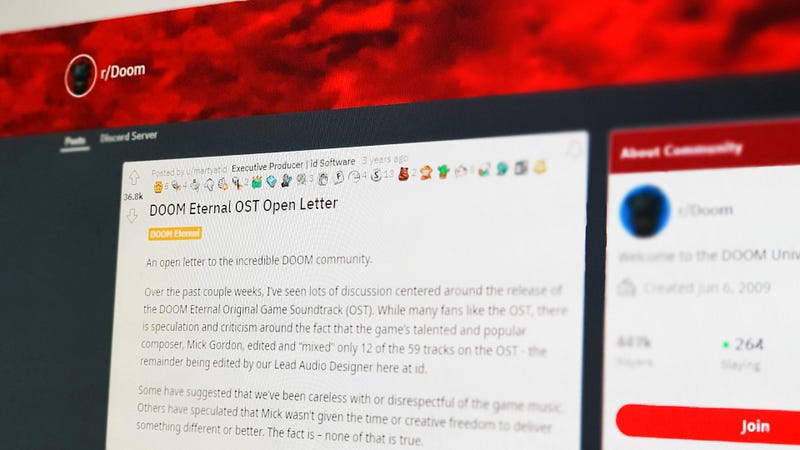 Marty lied and used disinformation and innuendo to blame me entirely for the failure of the DOOM Eternal Soundtrack
I couldn’t believe what I was reading: hadn’t we just agreed not to do this? Hadn’t we just agreed to a joint statement? Hadn’t Marty just told me he wanted to resolve this issue professionally?
I was horrified. Not just at Marty turning his back on what was our agreed path forward but also at his shameless disregard for the truth in his attack: the Reddit post was littered with lies and disinformation which directly contradicted the actual events and contractual clauses.
- Within hours the post was at the top of Reddit’s front page. It attracted thousands of comments, generated countless news articles and prompted many commentators to make YouTube videos.
- All were repeating Marty’s lies as truth because nobody thought the Executive Producer — now Studio Director — of a major AAA game development studio would go out on a limb and post a series of false accusations on Reddit.
Reddit: The DOOM subreddit, r/DOOM, isn’t an official page; it is run by fans and moderated by volunteers.
- Marty’s company Reddit account, “martyatid”, had been dormant for three years. He resurrected the account for this post, choosing the site to amplify his intent.
- He knew Reddit’s karma point system, ease of anonymous user account creation, swift aggregation of controversial material across subreddits, governance structure, and lack of policies around misinformation would result in damaging consequences for both my professional and personal reputation.
Reddit’s ongoing issues with toxic fandom and abuse are obvious, and the site’s history of notorious hate-campaigns targeting individuals in the game industry could not have been far from Marty’s mind.
- In taking to Reddit with a need to lay blame, he endorsed the platform and appealed directly to the worst aspects of it.
Breach of trust: Reading the Reddit post made me sick to my stomach. Lie after lie after lie, all pointing to me as the fault while posturing himself as the one who did nothing wrong. What hurt me the most was the feeling I’d been duped. I openly trusted Marty. Just days earlier, he told me he wanted to approach the situation professionally. To collaborate. That he had no intention of disparaging me. During our call, Marty told me he avoids social media and never posts online because he knows anything he says becomes the “next day’s news”. But here he was, using his platform to launch a direct personal attack. A public shaming event. A big put-down in front of the entire industry. Why? I felt humiliated. It was immediately clear to me that Marty had hostile intentions all along. He never wanted to work together. He wanted me on the call solely to gather information to create a scapegoat he could blame for the failure of the OST.
I’d been manipulated.
🔴 Detailed factual rebuttal of Marty Stratton’s claims link here
The Reddit post was a significant step in the wrong direction and was not the way to solve the problem. Instead of working with me on a professional outcome, Marty switched to stoking controversy by treating the issue as a scandal. Why he turned his back on me while misleading me to the contrary, when there was an opportunity to come together and work through the issue, without even seeking an alternative, is something I still don’t understand.
Lawyers become involved
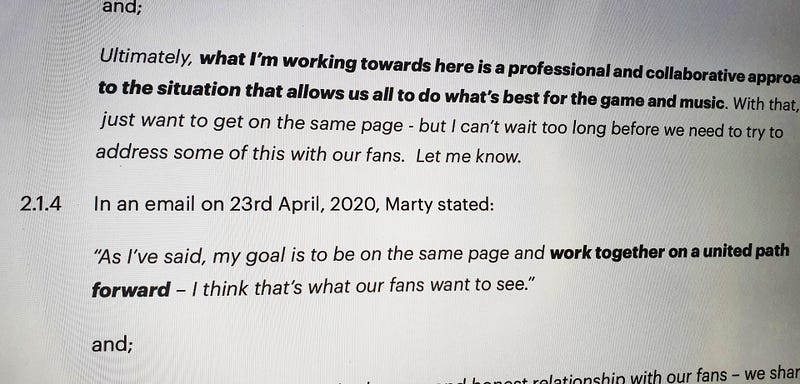
There wasn’t just one serious issue, but two: Marty published a series of false accusations against me, and id Software shipped DOOM Eternal with double the amount of music than what they paid for.
Lawyers: I immediately had my legal representative contact id Software with complaints about both matters. Marty forwarded my complaints to Zenimax, and within days I got a response from the executive legal authority from the upper echelons of the company.
- Zenimax assumed that Marty had acted appropriately and denied needing to pay me for the additional music.
To combat their stance, I:
- demonstrated Marty’s allegations directly contradicted contractual terms, public announcements and contents of emails and phone calls;
- concluded he exploited his position of authority to deliberately spread misinformation, used Reddit as a vehicle, and substantially damaged my reputation;
- showed that DOOM Eternal included almost five hours of music, over double what they agreed to pay me per the contract.
Once I presented those details, they quickly offered to settle.
Settlement offer negotiations
id Software and Zenimax engaged a large multi-national law firm as representation, and we began settlement negotiations. I demanded Marty withdraw his false accusations and issue an apology. But they rejected this on Marty’s concern that if he admitted fault publicly, that would negatively affect his reputation.
Instead, they proposed a deal: they would pay me the money owed, but on the condition I produce a new, polished version of the DOOM Eternal OST, appearing to suggest that if I gave them something to sell, that would somehow make up for the damage Marty had caused to my reputation.
Back-and-forth
I struggled with Marty’s insistence on avoiding accountability but realised his company was unlikely to agree to anything unless it was mutually beneficial. With that in mind, I agreed to produce a new, proper DOOM Eternal OST.
- However, I was unwilling to do the work while living under the shadow of ridicule and abuse stemming from Marty’s Reddit post. His actions severely eroded my trust in him, and I requested Marty take down the post as a sign of good faith.
But lawyers acting on Marty’s behalf expressed worry that even removing the post would reflect poorly on his reputation, which struck me as profoundly hypocritical: he should have thought about that before posting it in the first place.
In response, I told them my acceptance of their settlement offer was tied to the condition that Marty would remove the post immediately.
That prompted a spectacular meltdown
Their mood suddenly changed, and a threatening tone edged their letter of response. They withdrew the settlement offer and vowed the Reddit post was just the beginning. Marty was willing to issue legal proceedings to use the court process to damage my reputation further. They threatened legal action:
- over times I had discussed DOOM Eternal publicly, forcing me to remove my YouTube streams;
- and for using DOOM Eternal on my portfolio. Meaning I cannot share any of the music I produced for the game, and I had to remove any mention of DOOM Eternal from my website.
The letter then devolved into a bizarre rant that attempted to frame Marty’s behaviour not as wrongdoing but instead as something I deserved. But contrarily, that same letter presented me with a new settlement for damages caused anyway.
Hush money to bury the issue
The new settlement offer was a six-figure sum in return for taking full public responsibility for the failure of the OST. The details were absurd:
- Marty would keep the Reddit post up indefinitely. He’d never retract his false accusations nor clarify his statement, and his story would be forever considered the truth.
- I could never discuss DOOM Eternal, the OST, or the Reddit post. If ever asked, I had to say “no comment”.
- I had to pledge I would never badmouth Marty or anyone working under the Zenimax umbrella, and I could never criticise any product developed by a Zenimax studio.
I had to accept blame for the situation, under contract, for life. In return, I’d be paid a six-figure sum and Marty would save face and be free to continue on his way without any fear of interference of any kind from me.
Go to hell
As far as I was concerned, signing the gag order was out of the question. Giving up my right to tell the truth just to get some money was totally unacceptable. It meant having Marty walk all over me wasn’t so bad as to be beyond being paid off.
The truth is more important. I worked incredibly hard on the franchise, crunching for years to make it happen. My scores for both games were very successful: the companies who released them enjoyed the benefits. To have all that thrown away by someone who blatantly lied to portray me as a person who brings “uncertainty and risk” to any project, who now wanted to pay me off to preserve his reputation, was both troubling and hurtful.
Threats, abuse and harassment
Just when I thought things couldn’t get any worse, incidences of online abuse escalated at an alarming rate as Marty’s Reddit post led to frustration over my alleged professional failure, and toxic gamers grew openly aggressive.
- They shared my personal details via message boards, including Reddit, which meant that abusers could now reach me in more ways than ever.
- They email-bombed my inboxes, crashing the server and clogging my messaging services, crippling my ability to communicate.
- They harassed my other clients with attempts to get me fired from their projects.
- They called my phone numbers around the clock, screaming messages full of abuse.
I began receiving specific expressions of violence, the content so vivid it made me sick. The torrent of abuse telling me how to kill myself, how I’d be mutilated, how they would circulate photos of my body to traumatise my family, how my family would be murdered, how they’d hurt my animals, how they’d shoot up any event I attended, how I’d be raped to death, really started to wear me down in ways I couldn’t previously imagine.
Enormous strain
The spew of harassment coupled with legal threats from Marty put me under enormous strain. I began to feel isolated as the demands of the situation took their toll, and I desperately sought a way to resolve the matter.
Counter: I rejected the gag order and returned to the negotiation table with a counteroffer: remove the Reddit post, pay me for the extra music in DOOM Eternal, and I’ll produce another version of the OST. I hoped that presenting something they had previously asked for might persuade them to change their mind. I also shared details of the abuse, hoping the examples would spur Marty into retracting his false accusations and condemning the harassment.
Lawyers acting on Marty’s behalf requested time to discuss the offer, which gave me some hope.
Delays and stalling tactics
But then the stalling began, and over the coming months, I was subjected to every miserable delay tactic trick in the book.
They would request a meeting to discuss the settlement contract, suddenly postpone, reschedule, and then cancel at the last minute. We’d follow up, and they’d respond by requesting more time to consider the details. Chasing them again, they’d feed me bullshit excuses that always ended with “we’ll get back to you as soon as possible”. Next, they’d lead me on, saying their internal conversation was “heading in a positive direction” before delaying further because someone important who had input was holidaying in Miami.
It dragged on and on. As each week passed, bringing plenty of excuses peppered with hollow assurances of a positive outcome, it became more evident that I was being strung along. Until finally, after considerable time had passed, they came back with a response:
- They threw out the idea of ever redoing the OST and instead demanded the gag order only.
I looked at the email in dismay. After months of delays, meeting cancellations and postponements, they arrived precisely at the same place they started.
The acquisition
By now, the news broke that Microsoft would acquire Zenimax (including id Software) for $7.5 billion in cash. DOOM Eternal had been out for months and reviewed with great acclaim. But instead of celebrating the game’s success, I was caught up in a situation I can only describe as stupid.
Marty’s company had gotten to the point of offering to pay me off instead of addressing his inability to take responsibility for his behaviour, and toxic gamers were using his false accusations as a license to target me with relentless abuse, public shaming and violent rhetoric. All this over a video game soundtrack.
The absurdity of it all wasn’t lost on me.
The final offer
News of the acquisition gave me hope that now, with the pressure of a much larger entity looking over their shoulder, Marty might be encouraged to consider the benefits of a mutually beneficial outcome and rethink his position.
And so, for the second time, I proposed:
- I would produce a better version of the DOOM Eternal OST.
- But in return, I needed Marty to take down the Reddit post, publish a clarification and pay me for the extra music used in DOOM Eternal.
I can’t say I was keen on doing it, but I desperately tried to find a way to move forward and it was the only real option I had.
More stalling, threats & a giant waste of time
Again, lawyers acting for Marty were good at giving the impression of positivity. They seemed to be seriously considering the offer, saying they were taking it up the chain and getting “key stakeholders” onboard. However, any hope I had left eroded when they started to pull out the same old, tired, stalling tactics.
- As the months wore on, they became belligerent and inflexible, bringing nothing to the table but vague threats and circular arguments.
- They even degenerated into gaslighting tactics, trying to convince me that removing the Reddit post would somehow make my situation worse, so for the benefit of everyone, it should remain untouched.
They were unwavering in their insistence that the gag order was the only resolution possible, making it clear Marty had painted himself into a corner with no other way out.
Attempting to remove the Reddit post myself
I’d had enough. I grew tired of having the respect I afforded Marty, and his employer, with attempts to resolve the dispute privately, get turned into a giant waste of time, effort and money. The Reddit post had been up for 15 months and attempts to resolve the dispute with Marty had gotten me nowhere. With my patience stretched to the absolute limit, I decided to take steps to remove the Reddit post myself.
Reddit Moderator: I reached out to one of the r/DOOM moderators. We made contact and arranged a call via Discord.
The moderator introduced himself and spoke about his love for the DOOM franchise and its fanbase. Along with the r/DOOM subreddit, he told me he also moderated the official DOOM Discord server.
- I told him how Marty’s Reddit post had affected me deeply, both professionally and personally. It was a source of ongoing stress and harm, and I asked if he’d consider removing it.
Much to my relief, he instantly took it down.
But within 12 hours, the post was reinstated. The moderator blocked me on Discord and didn’t reply to my emails.
- A few days later, Marty’s lawyers contacted me and said removing the Reddit post had greatly offended him. He was furious and made it clear in the strongest terms that an amicable resolution would be impossible.
The purpose of this statement
Marty Stratton has put me in a position where the only step I can take to repair my reputation is with a public response. It is a defence, not an unprovoked attack, published as a last resort and with extreme reluctance only after every other avenue to reach a mutually agreeable resolution has failed.
I have given Marty ample opportunity to correct the false accusations he made against me, and all I’ve asked for is the truth and to be paid for my work. Stubborn refusal to address his Reddit post, out of fear for his image, has crippled Marty’s ability to offer anything but a gag order.
Marty seems to think so little of me that I’d give up my right to tell the truth and willingly accept the long-term mental health implications of publicly taking the blame for the situation in exchange for money. I can’t agree to protect him from the reality of what happened. The truth is more important, and signing a gag order would remove my ability to defend myself with the facts.
The only thing left to do is issue this public response.
Personal thoughts
I wish Marty had taken more time to consider better options before deciding that a Reddit post was the best course of action. It put his company in a position where they’re unable to do anything with DOOM Eternal’s music, it weaponised the fanbase against me, and sent a worrying signal to anyone working under him: if he’s willing to do this to me, he’s just as capable of doing it to anyone else.
Marty ends his Reddit post acknowledging an end to our “collaboration”. Collaboration: a word that describes people working together to reach a common goal, through trust, mutual respect and shared benefit. I’ve had an overwhelmingly positive career, filled with many great collaborations. I’ve worked on some great games, built lifelong friendships and worked my butt off in the trenches with some of the best creative minds on earth. I’ve had many great experiences in the game industry. My “collaboration” with Marty Stratton wasn’t one of them.
I never quit DOOM. I quit a toxic client.
Marty couldn’t accept that I never wanted to work with him again, and made his best attempt to send my career into a nosedive as punishment. He resorted to lies and innuendo that fell apart under the most basic level of scrutiny, then tried to bury the issue under a stack of cash.
Using NDAs, settlements and gag orders to silence truths is an appalling tactic used by people in high positions of power fearful of accountability. I am choosing to speak out because the alternative was to accept that tactic as okay.
It’s time to leave this sad state of affairs behind.
I’m forever thankful to the true-hearted folks who have continued to put their faith in me, even in the face of Marty’s attempts to damage my reputation. I’m happy to say the projects I’ve been a part of since have been some of the most rewarding experiences of my career. And I’m grateful to those around me who gave me love and support that kept me together when I was coming apart — they didn’t deserve to be put through this, either.
I’m looking forward to the future and all the great stuff around the corner.
-MG
Factual rebuttal of Marty Stratton’s claims in his Reddit “DOOM Eternal OST Open Letter”
Marty Stratton: “DOOM Eternal OST Open Letter”1. DOOM Eternal’s OST was poorly managed from the outset
The album was announced, with my name attached, and available for pre-order before I was under contract to produce it.
I learned about it in the media.
Marty then denied me the contract: I did everything possible to secure an OST agreement after the announcement. But time after time, Marty blocked every attempt I made.
- I frequently raised severe concerns about the situation but Marty refused to do anything about it.
- After months of inaction, I took my concerns to Bethesda and expressed my difficulties in getting id Software to do anything about the OST.
- Bethesda and I immediately began to negotiate the contract directly. We decided my contribution would only be 12 songs. Marty wasn’t involved in those discussions.
- I received the contract 48 hours before the game was released. By then, it had taken over nine months for it to materialise.
Consumer protection: Despite what Marty says, the exposure to consumer protection law risks was entirely self-inflicted. They brought that mess on themselves by including the OST in the Collector’s Edition before it was under contract. That screwup was made worse when Marty kept pushing the problem down the road resulting in a nine-month delay before I started working on it.
They would have avoided the entire situation by communicating their plans to me before the announcement and taking action much earlier.
2. The OST was delayed before I was under contract
 I wasn’t even under contract when the delay got announced.
Marty claims I demanded several extensions to the schedule, forcing him to delay the OST. But the truth is I wasn’t under contract until after the delay.
- Bethesda delayed the OST on March 11.
- I received the DOOM Eternal OST contract a week later, on March 18.
When Bethesda announced the delay on March 11, I was under no contractual obligation to produce the OST whatsoever. Before signing the agreement on March 18, I could have simply walked away from the project and left them to deal with the fallout.
Marty’s false accusation that I forced him to delay the OST has severely damaged my reputation. But it was Marty’s active refusal to do anything about the OST sooner which led to the delay.
At the time of the delay, I wasn’t even under contract.
3. The OST contract proves Marty’s claims are false
 Marty is wrong: I wasn’t under contract until March 18.
The DOOM Eternal OST contract, which is inarguable, provides further proof that Marty’s allegations against me are false.
3a. The actual deadline: Marty claims we signed the contract in “January”, and the deadline was “early March”. But that’s a total lie.
- I received and signed the contract on March 18.
- The deadline, clearly stated in the agreement, was April 16 (29 days later).
On Reddit, Marty implied that my timeline was much longer, and he claimed that I required several contract extensions that severely impacted the schedule. But the truth is I didn’t sign on until March 18. “January” was when I contacted Bethesda directly, out of desperation, as a last-ditch effort to get around Marty’s months of inaction on the OST.
3b. I was only paid to produce 12 songs: Marty conveyed the impression I was required to produce a “comprehensive OST” consisting of “30-tracks and a runtime of almost 2 hours”, before failing to deliver and only managing to produce 12 songs instead.
But the contract was only for 12 songs.
- I was given just enough time and budget to deliver 12 songs, not 30, which is clearly outlined in the contract.
- Bethesda and I discussed the possibility of a larger OST during the negotiation phase, but the suggestion was thrown out almost immediately because reality deemed it impossible.
- Marty wasn’t involved in that discussion.
Marty’s snap decision to release a “comprehensive OST” came just days before the all-important deadline, when it was impossible to renegotiate the deal to accomodate his sudden change of direction. If I had been offered the contract nine-months earlier, when they put it up for pre-order, a well-produced full-length album would have been possible.
3c. I didn’t have creative control: Marty claims otherwise, which is entirely false. The proof is that contract explicitly grants id Software complete creative control, and they had absolute authority over every decision.
- id Software exercised creative control extensively, deciding on the structure of the album, what songs to include, which to omit, the track titles, track order, album art and credits. They even changed the names of some tracks I directly contributed.
- The final album’s details were withheld from me, and I wasn’t allowed to hear it once before release.
- id Software was not obligated to seek my approval for anything, nor did they ask for it.
Marty took it upon himself to get involved in the album’s production during the final days of the project. He cut me out at the last stage and decided to release their own poorly edited version instead. I voiced my concerns about Chad’s editing and provided details regarding loudness standards, but they ignored those details. I didn’t approve the final album because Marty and Chad withheld it from me.
The situation was opposite to my experience on DOOM 2016’s OST: id Software didn’t interfere in the production of that album at all.
3d. id Software’s access to the source material: Marty pretends they had no access to the material. But that is a lie; they absolutely did have access to the source material.
- I was contractually obliged to hand over all stems, mix sessions, production files, raw recordings, demos, mockups, and other source files.
- The contract explicitly states that all my source files become the property of id Software, and they own all files I created for DOOM Eternal.
The reason their edits weren’t good enough was not due to a lack of source material; it was a lack of standards.
Marty knew the truth: as Studio Director of id Software and Executive Producer on DOOM Eternal, he had detailed knowledge of the contract terms and what was agreed upon by all parties. Therefore, he made these false accusations against me willingly.
I still can’t fathom why Marty claimed to be telling “the entire story”, knowing I could simply point at the contract as proof against him.
4. They paid me for the OST without dispute
Nobody argued against payment: the most substantial proof that Marty’s Reddit post is utter bullshit is the fact that they paid me afterwards for fulfilling the contract.
- id Software approved my OST contribution after I did everything asked of me.
- Marty was part of the panel that approved it.
He then went on to make wild claims about my supposed unprofessional behaviour. But had I behaved in such a way that Marty alleges, id Software, Bethesda, and Zenimax would have had clear grounds to refuse payment. However they made no argument against it; they paid me the total contracted amount, including the on-time bonus, because I met all my contractual requirements.
5. id Software had been working on the OST for six months, without me, before I was under contract
On Reddit, Marty alleged my performance was so bad that he was forced to enlist Lead Audio Designer Chad Mossholder at the last minute to save the OST.
But the BWF metadata tells the true story: Chad sent me a preliminary version of his edited OST one week before my deadline. Metadata within these files show that Chad began working on his version of the OST using Reaper six months earlier when he and Marty were actively excluding me from working on it:
id Software had been working on an alternative OST for at least six months before I got the contract.6. Marty doesn’t seem to understand the mastering process
Marty says that Chad, apparently working in a hurry, only had my supposed “bricked” in-game score to work with. He points to my so-called “bricked” score and adopts that as the reason behind Chad’s poor editing. But not only is Marty confused and clearly doesn’t understand the mastering process, but he also seems ignorant of how Chad’s editing introduced significant problems.
The editing was poorly done: to make his OST edits, Chad cut bits out of my already-mastered in-game score and arbitrarily copy-pasted these bits together to create “songs”. But he carelessly pasted those bits directly on top of each other, frequently off-grid and out-of-time, without even a crossfade to cover the transition.
- As a result, his edits are full of abrupt tempo changes, awkward gaps, jarring transitions, clicks, pops and clipping.
How Chad edited the OST files and how I mastered the in-game score are two completely unrelated things. The errors introduced via his editing have nothing to do with how I originally mastered the in-game score.
id Software approved my mastering: I ensure my in-game scores always adhere to conventional mastering standards. id Software approved all my in-game music and how I mastered it, and at no point did anyone complain that my masters were “bricked”.
The problems were introduced by pasting two already-mastered audio files directly on top of each other.
- Doing so caused dramatic amplitude spikes at the edit point. Chad didn’t bother to crossfade the transition: both files play simultaneously (causing spikes at double the volume).
- To compensate, he “remastered” the edited song by normalising it to 0dBFS — a rudimentary error.

His edits are riddled with these clearly visible mistakes. Anyone comparing my original tracks to his edits can hear (and see, by looking at the waveform) the unmistakable errors introduced during the editing process.
7. The obvious problems immediately drew valid criticism

A Twitter user pointed out the stark differences between my original BFG Division (2016) and Chad’s edited versions and identified the same errors introduced via the poor editing I described above.
I had to respond: unknown to them at the time, the people criticising the album were under the impression I was responsible for the mistakes. The public began attributing the errors to me, calling my work into question, which put me in a position where I had to respond. And so I made a single comment that clarified my limited involvement.
Why? Because it’s the truth.
But Marty didn’t see it that way. His “Open Letter” made it clear to me that he took my act of pointing out the truth as committing an unforgivable sin of disloyalty. What did he expect me to do? Blindly support an album of messed-up versions of my songs, most of which I’d never heard before? To do so would have been a lie.
8. ”Doubt we’ll ever work together again”
Marty highlighted that comment I made, in private, in response to someone asking if I wished to continue working with id Software.
I said what I said because, quite honestly, I got sick of dealing with a toxic client. Years of crunch, pay withheld for months, unhealthily stressful situations — the issues became too difficult to ignore.
It’s a shame. Because on both DOOM and DOOM Eternal, I had the great fortune of working directly with enormously talented people whose creative ideas and technical wizardry led to both games’ success. My statement, issued in response to Marty Stratton, has nothing to do with the rest of the DOOM team. Lamentably, the joy I got from working with them was outshined by the other issues I’ve highlighted. Problems so serious it tainted my experience to make DOOM Eternal the worst project I’ve ever been involved with.
Charade: Marty took great offence to my comment, claiming he was “surprised” because allegedly it was the “first time we discussed ending our collaboration”. But the truth is I had my DOOM contracts threatened several times, and Marty himself even made such a threat.
Knowing the truth, Marty’s dramatic reaction to my comment is one of several phrases that stood out to me as blatant posturing. I will draw attention to two others:
- Credits. Marty justifies crediting Chad as a co-artist on the album (which I disagree with) by saying it was the fair thing to do. But, his reasoning is deeply hypocritical because id Software flat-out refused to credit several of my long-term collaborators for their work on DOOM Eternal. Their direct contributions were vital to the sound of the score. They were big DOOM fans who were excited to work on the game and performed their very best. They were heartbroken when id Software downright refused to credit them. Marty claims to hand out credits fairly, but that is insincere.
- Awards. I’m happy to hear Marty feels I deserve DOOM’s music awards because the truth is those trophies are kept locked in the id Software office. I’ve only ever seen them once. Behind glass. From a distance. Nobody has ever offered to send me copies. Thanks to the show’s producers, I was invited to perform at the Game Awards, but other than that, id Software never invited me to collect awards in person. Marty invited himself to collect the awards on my behalf instead. It would mean a lot to have a memento of all the hard work I poured into the DOOM franchise, but as it currently stands, I doubt I’ll ever see those awards again.
9. The most hurtful lie
In a grubby move, and without proof, Marty alleged I instigated a campaign of harassment targeting id Software employees. In a baseless claim that is a total lie, he directly accused me of making statements that “led some to vilify and attack an id employee”. This outrageous accusation, used as the rationale for his Reddit post, was designed to undermine my character and provoke a strong emotional response.
- Later, this horrid, ill-founded allegation prompted lawyers acting on Marty’s behalf to offer me a six-figure settlement to cover damages.
Attacking me further, he claims I did “nothing to change the conversation”. An astonishing claim, because just days earlier, I was on a call with Marty, making myself fully available for anything he needed. He specifically asked me not to make any public comment until we could address the public together — which clearly was nothing more than a strategy to buy himself time to prepare the Reddit post.
Key facts: Marty agreed to announce, attach my name, and take pre-orders on the OST before I was under contract and then actively blocked me from working on it. He drew Chad into the situation, instructing him to produce an alternative OST instead, without my direct involvement. Marty green-lit Chad’s version as the offical album and approved Chad’s name to be featured as a co-artist. Most importantly, Marty first highlighted Chad’s involvement publicly as part of his Reddit post.
Marty’s narrative that he was compelled to publish an Open Letter on Reddit out of the necessity of protection is a manufactured threat that didn’t exist and was used to justify his actions. Because if any such threats did exist, Marty’s company has policies, procedures, safety protocols and security measures readily available to deal with such issues. Posting 2500+ words on Reddit to name, shame, and direct blame toward an individual (me in this case) is not one of those policies.
- And frankly, using the guise of “staff safety” as an excuse to attack someone on Reddit is fucking disgusting.
Bold decisions: Marty took the effort to point out I had “knowledge” of his decision to enlist Chad, going so far as to use bold text to highlight the point. But he also held back from saying:
- I thought the edits weren’t up to standard;
- I voiced my anxiety over their release;
- and I never approved the final album.
As the project’s Executive Producer, Marty is entirely in charge of his decisions. Telling a subordinate about your decision does not shift the responsibility to that person if that decision goes wrong.
Summary of Facts
DOOM Eternal
I haven’t been paid for over half of DOOM Eternal’s music: The game includes more than double the music I was contracted to produce. Rejects, mockups, demos, many of which were never meant for public release. I created this music as part of the development process and shared it with id Software in good faith. But id Software used the music in the game, marketing and soundtrack and still refuses to pay me for it.
The DOOM Eternal OST was a mess
It was announced, with my name attached, and made available for pre-order before I was contracted to produce it. Despite my alarm and constant appeals Marty refused to do anything about the situation, leading to a nine-month delay before I could start work.
- After seven months of inaction, I reported my concerns to Bethesda.
- Bethesda and I negotiated the DOOM Eternal OST directly, without Marty’s involvement.
- I received the contract on March 18, 2020, just 48 hours before DOOM Eternal was released. The delay was announced a week earlier before I was under contract.
The deadline was April 16 (29 days later) and the contract stipulated id Software had complete creative control and would aquire access to all my source material.
Marty withheld crucial details from me until 13 days before my deadline, such as:
- Potential legal trouble they faced for taking pre-orders before it was under contract.
- Details about their internally-produced OST: an alternative edited from my in-game score, which they’d worked on for at least six months without my knowledge or involvement.
I didn’t approve the release: In the days leading up to April 16, Marty cut me out of the process and decided to release their alternative version instead, reducing my direct contributions to filler. Both he, and id Software’s Lead Audio Designer, Chad Mossholder, didn’t allow me to hear the final album and didn’t seek my approval; they weren’t contractually required to do so.
OST release
Their poor-quality release immediately drew criticism, and a worried Marty personally asked me for assistance in addressing the situation. I made myself entirely available to Marty and committed to satisfying disappointed customers with a better OST. Marty made it clear he wanted me involved, saying he wanted a positive outcome, had no ill intentions and wanted to resolve the issue professionally.
- He offered to draft a joint statement addressing the situation and announcing plans to move forward.
- He requested I hold off on making further public comments until we could address the public together.
Marty told me to expect the draft within hours, but it never arrived.
Instead, days later, he published a 2500+ word “open letter” on a fan-run Reddit page that singled me out as the sole cause behind the botched OST. The post attracted thousands of comments and news articles and severely damaged my personal and professional reputation. Worst of all, he did it behind my back whilst leading me on with a bullshit story about working together on a professional solution to the problem.
His statement was full of lies, disinformation and innuendo, and when challenged, his company offered me a six-figure sum to shut up about it. When I tried, time and time again, amid a torrent of abuse, harassment and threats, to resolve the matter more amicably, he constantly refused, worried how addressing the Reddit post would damage his own reputation instead.
But as far as I’m concerned, truth and honesty are more important: Marty’s words damaged my character and attacked my reputation. I have afforded him ample opportunity to address this issue, but his refusal to do so has left me with no option other than to issue this statement.