How False Oppositions Shape American Politics and Culture
Introduction: Understanding the Illusion of Choice
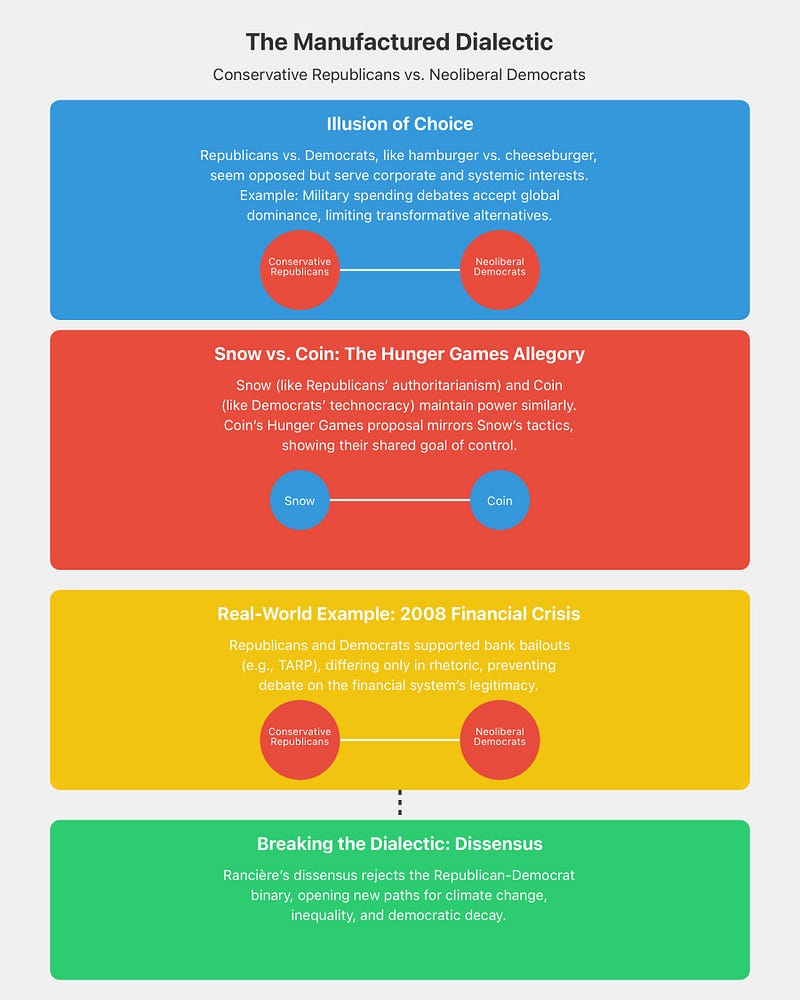
Imagine walking into a restaurant where the menu offers only two options: a hamburger or a cheeseburger. The waiter enthusiastically explains the fundamental differences between these choices, describing passionate debates between hamburger and cheeseburger enthusiasts. Customers argue heatedly about their preferences, forming loyal communities around their chosen option. Yet both meals are essentially the same — ground beef on a bun — with only superficial variations. Meanwhile, no one questions why the menu doesn’t include pasta, salad, or soup.
This scenario captures the essence of what our theory calls the “manufactured dialectic” — a system that creates the appearance of meaningful opposition while channeling all choices within parameters that serve the same underlying interests. Suzanne Collins’ The Hunger Games trilogy provides a powerful allegorical framework for understanding how this dynamic operates in American politics and culture, revealing how apparent enemies often serve identical structural functions.
The Foundation: What Makes a Dialectic “Manufactured”?
To understand manufactured dialectics, we must first grasp what genuine dialectical thinking involves. In classical philosophy, a dialectic represents the clash between opposing forces — thesis and antithesis — that generates new possibilities through their interaction. This process creates genuine transformation because each side fundamentally challenges the other’s assumptions.
A manufactured dialectic, by contrast, presents what appears to be opposition but operates within shared assumptions that remain invisible and unchallenged. The competing sides may use different language, appeal to different emotions, and attract different supporters, but they ultimately serve the same structural interests. The debate becomes a form of theater that channels dissent into predetermined pathways while preventing genuine alternatives from emerging.
Consider how this works in practice. When two political parties debate the size of military spending, they may disagree about specific amounts or priorities, but both accept the fundamental premise that maintaining global military dominance serves national interests. The debate stays within parameters that benefit defense contractors and foreign policy establishments regardless of which side “wins.” The manufactured dialectic succeeds because it makes this shared assumption invisible while creating the impression of meaningful choice.
The Allegorical Framework: Snow and Coin as Political Archetypes
Suzanne Collins’ creation of President Snow and President Coin provides a brilliant illustration of how manufactured dialectics operate. These characters appear to represent fundamentally opposed worldviews, yet their similarities reveal the illusory nature of their opposition.
President Snow governs through what political theorists call “sovereign power” — direct, visible control that doesn’t hide its brutality. He rules through spectacle, fear, and patriarchal authority. His approach to maintaining order involves public executions, ritualized violence, and the constant reminder that resistance will be crushed. Snow represents the traditional conservative approach to governance: hierarchy is natural, order requires strength, and dissent must be eliminated.
President Coin, by contrast, embodies what we might call “technocratic governance” — rule through bureaucracy, moral rhetoric, and the appearance of rational administration. She speaks the language of justice, liberation, and democratic values. Her approach to maintaining order involves committees, votes, and appeals to higher principles. Coin represents the liberal approach to governance: hierarchy must be justified, order requires consent, and dissent must be managed.
The crucial insight emerges when we examine their actions rather than their rhetoric. Both leaders manipulate public sentiment through carefully orchestrated spectacles. Both sacrifice innocent lives for strategic advantage. Both maintain rigid hierarchical structures that concentrate power in elite hands. Most tellingly, both use the Hunger Games as a tool of political control — Snow to terrorize the population into submission, Coin to satisfy demands for symbolic justice.
The parallel becomes unmistakable when Coin proposes reinstating the Hunger Games with the children of former Capitol citizens as tributes. This moment reveals that she has internalized the same logic of ritualized violence that defined Snow’s regime. The difference lies not in the fundamental structure of power but in the justification provided for its exercise.
Historical Patterns: How American Politics Exemplifies Manufactured Dialectics
The relationship between Snow and Coin mirrors historical patterns in American politics that reveal how manufactured dialectics operate in practice. Understanding these patterns requires examining how political parties have maintained structural continuity while appearing to undergo fundamental transformations.
Consider the dramatic apparent reversal of American political parties during the mid-twentieth century. The Republican Party began as the progressive force of Lincoln and Reconstruction, advocating for industrial modernization, civil rights, and federal intervention against state-level oppression. The Democratic Party, particularly in the American South, defended slavery, segregation, and states’ rights against federal authority. By the 1960s, these positions had seemingly reversed completely, with Democrats becoming the party of civil rights and federal intervention while Republicans embraced states’ rights and resistance to federal authority.
This transformation appears to represent a genuine ideological evolution until we examine the underlying structural continuities. Both parties consistently aligned with the interests of dominant economic elites, adapting their rhetorical frameworks to accommodate shifting coalitions without challenging fundamental power relationships. The Republican “Southern Strategy” and Democratic embrace of civil rights represented strategic realignments rather than ideological conversions. The deeper pattern becomes visible when we trace how both parties have consistently supported policies that serve corporate interests while using different rhetorical justifications. Both parties supported the development of the national security state, the financialization of the economy, and the expansion of global trade regimes that benefited multinational corporations. The debates focused on implementation details and justificatory frameworks rather than questioning whether these policies served ordinary Americans’ interests.
This pattern mirrors the Snow-Coin dynamic perfectly. Like Snow’s open authoritarianism and Coin’s technocratic control, conservative and liberal approaches to governance offer different styles of elite management while maintaining the same fundamental structure of power concentration.
Contemporary Manifestations: The Manufactured Dialectic in Practice
To understand how manufactured dialectics shape contemporary American politics, we must examine specific policy areas where apparent opposition masks underlying consensus. These examples illustrate how the dynamic operates across different domains of governance.
Foreign policy provides perhaps the clearest example of manufactured dialectic in action. Democrats and Republicans engage in intense debates about military interventions, defense spending, and diplomatic strategies. Democrats emphasize humanitarian concerns, international cooperation, and multilateral institutions, while Republicans stress national strength, bilateral relationships, and military deterrence. The rhetoric differs dramatically, creating the impression of fundamental disagreement about America’s role in the world.
Yet both approaches consistently result in massive military budgets, global military presence, and interventions that serve geopolitical rather than humanitarian interests. The debates focus on tactics and justifications rather than questioning whether maintaining global hegemony serves ordinary Americans’ interests. Whether framed as “humanitarian intervention” or “national security,” the policies benefit defense contractors, foreign policy establishments, and corporate interests that profit from global instability.
The 2008 financial crisis revealed another striking example of manufactured dialectic in economic policy. Both parties initially engaged in populist rhetoric about Wall Street excess and the need to protect ordinary Americans from financial predation. Democrats emphasized the need for regulation and government intervention to prevent future crises, while Republicans stressed the importance of free markets and minimal government interference.
Despite this apparent opposition, both parties ultimately supported policies that socialized losses for financial institutions while privatizing their gains. The banking bailouts, quantitative easing programs, and regulatory reforms maintained the fundamental structure of financialized capitalism while channeling public anger into debates about implementation details. The manufactured dialectic succeeded because it made the shared commitment to preserving existing financial structures invisible while creating the impression of meaningful choice about how to address the crisis.
Healthcare policy demonstrates how manufactured dialectics can operate even in areas where genuine policy differences exist. Democrats advocate for expanded government programs, universal coverage, and public options, while Republicans push for market-based solutions, private insurance, and reduced government involvement. These positions appear fundamentally opposed and do result in different outcomes for many people.
However, both approaches accept the fundamental premise that healthcare should be organized as a commodity rather than a public good. Even the most progressive Democratic proposals typically involve subsidizing private insurance companies and pharmaceutical corporations rather than challenging the profit-driven nature of American healthcare. The debate stays within parameters that ensure continued profitability for healthcare industries regardless of which approach prevails.
Cultural Extensions: How Manufactured Dialectics Shape Consumer and Social Life
The manufactured dialectic extends far beyond formal politics into cultural realms where it shapes how Americans understand choice, identity, and social relationships. These cultural manifestations reveal how the dynamic operates at a deeper level than conscious political decision-making.
Consumer culture provides abundant examples of manufactured dialectics in action. Consider the intense rivalry between technology companies like Apple and Microsoft, or beverage companies like Coca-Cola and Pepsi. These corporations spend enormous resources positioning themselves as fundamentally different, creating passionate loyalty among consumers who identify strongly with their chosen brands.
The “Mac versus PC” debate exemplifies this dynamic perfectly. Apple positions itself as creative, rebellious, and user-friendly, appealing to consumers who see themselves as artists, innovators, and independent thinkers. Microsoft emphasizes productivity, reliability, and compatibility, attracting users who prioritize efficiency, professionalism, and practical functionality. The competition appears intense, with users developing strong emotional attachments to their chosen platforms and engaging in passionate debates about their superiority.
Yet both companies operate within the same capitalist framework, both collect user data for commercial purposes, both encourage planned obsolescence to drive continued consumption, and both reinforce the notion that technological consumption equals personal expression. The manufactured dialectic succeeds because it channels the genuine human desire for identity and community into predetermined commercial categories while making the shared commitment to profit maximization invisible.
Media and entertainment industries demonstrate similar patterns. Streaming services compete fiercely for market share while all promoting the same basic model of commodified entertainment consumption. Netflix emphasizes original content and algorithm-driven personalization, while Disney+ focuses on established franchises and family-friendly branding. Amazon Prime integrates entertainment with broader commercial ecosystems, while HBO Max positions itself as prestige television for sophisticated audiences.
The competition appears intense, with consumers developing strong preferences and engaging in cultural debates about quality, value, and content. Yet all these services operate according to the same fundamental logic: transforming human creativity and cultural expression into commodities that generate profit through subscription models and advertising revenue. The manufactured dialectic channels genuine desires for entertainment, community, and cultural meaning into predetermined commercial categories while preventing questions about whether this model serves human flourishing.
Educational institutions provide another illuminating example of manufactured dialectics in cultural life. Public schools and charter schools are presented as fundamentally different approaches to education, generating intense political debates about funding, governance, and educational philosophy. Public school advocates emphasize democratic values, equity, and community control, while charter school proponents stress innovation, choice, and accountability.
Yet both systems increasingly operate according to standardized testing regimes that reduce learning to measurable outcomes and prepare students primarily for economic productivity rather than critical thinking or civic engagement. The manufactured dialectic succeeds because it channels genuine concerns about educational quality into predetermined categories while making the shared commitment to instrumental education invisible.
The Moment of Recognition: Snow’s Laughter as Ideological Rupture
One of the most psychologically penetrating moments in The Hunger Games occurs when President Snow laughs upon witnessing President Coin’s assassination. This laughter represents more than sadistic pleasure — it constitutes what we might call an “ideological rupture,” a moment when the manufactured dialectic becomes visible and its absurdity is revealed.
Snow’s laughter emerges from recognition rather than madness. He sees that Coin has become exactly what she claimed to oppose, reproducing the same authoritarian logic under the guise of justice and liberation. Her belief in her own moral superiority made her vulnerable to this transformation because she couldn’t recognize how her methods contradicted her stated values. Snow laughs because he understands the game better than Coin did — he never pretended to be anything other than what he was.
This moment connects to what philosopher Peter Sloterdijk calls “cynical reason” — the phenomenon where people recognize ideological absurdity but continue participating in it anyway. Snow’s laughter represents the cynical recognition that even “revolutionary” politics ultimately serve the same elite logic. He sees Coin’s demise as confirmation that the manufactured dialectic is inescapable, that any attempt to create genuine alternatives will eventually reproduce the same structures of domination.
The psychological insight here is crucial for understanding how manufactured dialectics maintain their power. They succeed not only by making alternatives invisible but by creating cynical resignation about the possibility of change. When people recognize that apparent oppositions serve similar functions, they often conclude that all politics is inherently corrupt rather than imagining possibilities that transcend the false choices presented by existing systems.
Snow’s laughter thus represents both the exposure of manufactured dialectic and its ultimate triumph. The recognition of ideological absurdity becomes a source of cynical superiority rather than motivation for genuine transformation. This dynamic helps explain why many Americans become politically disengaged or cynical rather than seeking alternatives when they recognize the limitations of existing political choices.
The Rupture: Katniss and the Refusal of False Synthesis
Katniss Everdeen’s decision to kill President Coin instead of President Snow represents a fundamentally different response to the recognition of manufactured dialectic.
Rather than accepting cynical resignation like Snow, or falling into ideological self-deception like Coin, Katniss enacts what philosopher Theodor Adorno called “negative dialectics” — the refusal to accept false synthesis between inadequate options.
Traditional dialectical thinking seeks to resolve contradictions through synthesis, finding a middle ground or higher unity that incorporates elements of both thesis and antithesis. Negative dialectics, by contrast, maintains that some contradictions cannot and should not be resolved because both sides of the opposition are fundamentally flawed. The appropriate response is not synthesis but refusal — the rejection of the entire framework that creates the false choice.
Katniss’s action embodies this principle perfectly. She refuses to choose between Snow’s open authoritarianism and Coin’s technocratic control, recognizing that both options serve the same structural function of maintaining elite domination. By killing Coin, she doesn’t solve the problem of political authority but rather exposes the illegitimacy of the entire system that presents these as the only alternatives.
This gesture represents what political theorist Jacques Rancière calls “dissensus” — a rupture in the symbolic order that reveals the contingency of existing arrangements. Dissensus differs from mere disagreement because it challenges the fundamental categories through which political debate is conducted. Rather than arguing within established parameters, it questions the legitimacy of those parameters themselves.
Katniss’s refusal becomes genuinely radical because it offers no replacement for the system it rejects. This absence of positive program is not a weakness but a strength — it prevents the revolutionary gesture from being co-opted into new forms of domination. By refusing to become a new leader or endorse a new system, Katniss maintains the purity of her refusal and keeps open the possibility of genuine alternatives.
The psychological courage required for this kind of refusal cannot be understated. It requires abandoning the security of choosing between predetermined options and accepting the anxiety of genuine uncertainty. Most people find it easier to choose between flawed alternatives than to reject the entire framework that creates those alternatives, even when they recognize its inadequacy.
Pathways Beyond the Manufactured Dialectic
Understanding manufactured dialectics naturally leads to questions about what genuine alternatives might look like. However, approaching this question requires careful thinking about what it means to move beyond existing frameworks rather than simply choosing different options within them.
The first step involves developing what we might call “dialectical literacy” — the ability to recognize when apparent oppositions serve similar structural functions. This skill requires looking beyond surface-level differences to identify shared assumptions that remain invisible in mainstream debates. When people argue about competing options, dialectical literacy asks what questions aren’t being asked and what possibilities aren’t being considered.
For example, when people debate whether to fund education through property taxes or state funding, dialectical literacy notices that both options assume education should be organized around preparing students for economic competition. Neither side questions whether this instrumental view of education serves human development or democratic participation. Developing dialectical literacy means learning to identify these kinds of shared assumptions and imagining possibilities that transcend them.
Genuine alternatives often involve what political theorist James C. Scott calls “seeing like a citizen” rather than “seeing like a state.” This perspective prioritizes human-scale institutions, direct participation, and local knowledge over bureaucratic efficiency, professional expertise, and standardized solutions. It suggests that many problems attributed to insufficient government intervention or excessive government interference actually stem from the concentration of power in distant institutions that cannot respond to local needs and knowledge.
Participatory democracy provides one example of thinking beyond manufactured dialectics. Rather than choosing between different forms of representative government, participatory approaches involve people directly in making decisions that affect their lives. This might include neighborhood assemblies, workplace democracy, and community control over resources. These approaches don’t fit neatly into traditional left-right categories because they operate according to different principles entirely.
Economic alternatives might involve cooperative ownership models that reject both corporate capitalism and state socialism. Worker cooperatives, community land trusts, and mutual aid networks create economic relationships based on solidarity rather than domination. These models remain largely invisible in mainstream political debate because they don’t fit the parameters of the manufactured dialectic between free markets and government intervention.
The key insight is that genuine alternatives often appear impossible or impractical within existing frameworks precisely because those frameworks are designed to make alternatives invisible. When people say “there is no alternative” to current arrangements, they’re usually speaking from within a manufactured dialectic that has successfully narrowed the range of conceivable options.
Developing Critical Practice: Tools for Recognition and Resistance
Understanding manufactured dialectics intellectually is only the first step toward developing the practical skills needed to recognize and resist them in daily life. The next step requires cultivating what we might call “critical practice” — habits of thought and action that maintain awareness of how false oppositions operate while creating space for genuine alternatives.
One essential skill involves learning to ask different kinds of questions when confronted with heated debates between competing options. Instead of immediately taking sides, critical practice asks what assumptions both sides share, what interests they serve, and what possibilities they exclude. This doesn’t mean becoming cynical about all political engagement but rather developing the capacity to see beyond the immediate terms of debate.
Another crucial skill involves recognizing the emotional and psychological mechanisms through which manufactured dialectics maintain their power. These systems succeed partly because they provide people with a sense of identity, community, and purpose through identification with particular sides. Learning to satisfy these genuine human needs through alternative means — community involvement, creative work, mutual aid — reduces susceptibility to manufactured choices.
Critical practice also involves cultivating what philosopher Simone Weil called “attention” — the capacity to remain present to reality without being swept away by ideological narratives or emotional manipulation. This kind of attention allows people to notice when their genuine concerns are being channeled into predetermined categories and to maintain space for responses that transcend those categories.
Perhaps most importantly, critical practice involves experimenting with alternative forms of organization and relationship in daily life. This might include participating in cooperative enterprises, engaging in mutual aid activities, or creating communities based on principles other than competition and domination. These experiments provide concrete experience of alternatives that can serve as foundations for broader social transformation.
Conclusion: The Ongoing Relevance of Allegorical Thinking
The Hunger Games provides more than entertainment — it offers a diagnostic tool for understanding how power operates in contemporary American society. The relationship between Snow and Coin illuminates patterns that extend far beyond fictional dystopia into the real dynamics of political, economic, and cultural life.
The manufactured dialectic succeeds because it harnesses genuine human desires for choice, identity, and meaningful participation while channeling these desires into predetermined pathways that serve existing power structures. Recognizing this dynamic is the first step toward imagining and creating alternatives that transcend false oppositions.
Katniss’s refusal offers a model for how individuals can respond to manufactured dialectics without falling into cynical resignation or ideological self-deception. Her gesture suggests that authentic political action begins with the courage to refuse false choices and remain open to possibilities that existing frameworks cannot accommodate.
The contemporary relevance of this analysis becomes clear when we consider how manufactured dialectics shape everything from electoral politics to consumer culture to educational institutions. Understanding these patterns provides tools for recognizing when genuine concerns are being channeled into false oppositions and for maintaining space for responses that transcend predetermined categories.
The path forward involves neither choosing between existing alternatives nor withdrawing from political engagement altogether. Instead, it requires developing the skills and communities necessary for creating genuine alternatives that serve human flourishing rather than elite domination. This work begins with individual recognition but ultimately requires collective action to create institutions and relationships based on principles other than those that govern existing systems.
The manufactured dialectic maintains its power partly through the illusion that it encompasses all possible options. Breaking this illusion requires both intellectual understanding and practical experimentation with alternatives. The Hunger Games provides the allegorical framework for this understanding, but the real work of creating alternatives must take place in the concrete circumstances of daily life.
As we face contemporary challenges that existing institutions seem incapable of addressing — climate change, inequality, democratic decay — the need for thinking beyond manufactured dialectics becomes increasingly urgent. The courage to refuse false choices and remain open to genuine alternatives may be the most important political skill for navigating the complexities of twenty-first-century life.