How we make digital math learning inclusive for all with Access8Math, an NVDA add-on
Learning in the digital world has become ubiquitous, even in subjects like math. However, this shift poses significant challenges for visually impaired students, especially when it comes to complex visual elements like equations and diagrams. These elements are difficult to interpret accurately by screen readers, such as NVDA (NonVisual Desktop Access), which are the typical tools used by visually impaired students to access digital content.
In this article, I’d like to share the problems that these students and their teachers face, along with the solutions we’ve designed and developed to address these challenges, helping you understand this overlooked and uncharted area of digital education technology.
The challenges visually impaired students face when learning math in the digital world
Blind or visually impaired students learning math often rely on screen readers to read mathematical content aloud and use tactile resources like Nemeth Braille, which help them interpret math through touch.
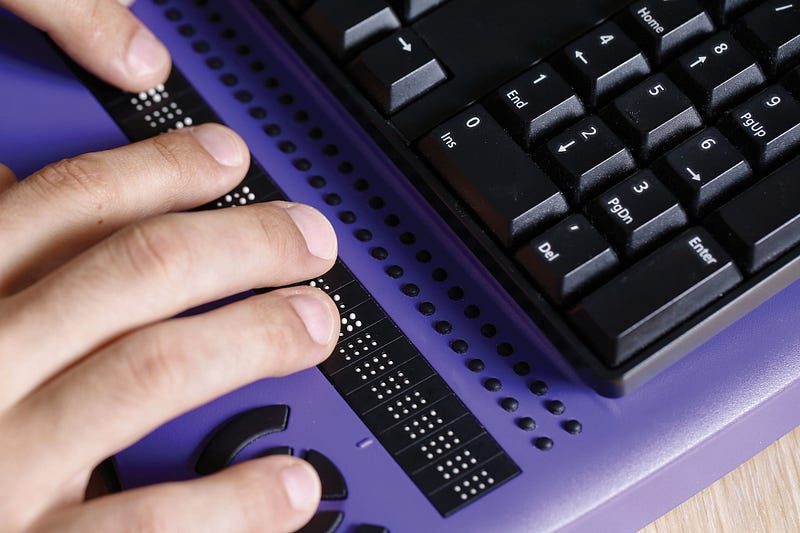 Blind users interact with the internet and digital software using a Braille keyboard (Photo by Rosenfeld Media)
 Two examples of the formulas shown using Nemeth Braille code (source from The Nemeth Tutorial)
However, in today’s digital world, these students face significant challenges in learning math, particularly with complex visual elements like equations and diagrams that screen readers struggle to interpret accurately.
For teachers, there is the added challenge of learning to use assistive technology and tools. Learning Nemeth Braille and creating tactile graphics, and translating equations to digital format require extra time and effort.
These challenges are further highlighted by a 2012 study, which found that approximately 11% of secondary school students with disabilities pursued post-secondary education, and 23.2% of them chose STEM fields (Science, Technology, Engineering, and Mathematics) — a figure nearly the same as the 24.7% of students without disabilities. However, many students with disabilities face significant challenges in completing their degrees, with blind students often encountering even greater barriers due to the limited availability of fully accessible learning resources.
The limitations of the NVDA screen reader in math learning
NVDA (NonVisual Desktop Access) is a comprehensive screen reader in Windows that provides accessibility for a wide range of digital content, making it useful for accessible learning. It is also free for anyone to use.
(Note: A 9-minute YouTube video demonstrated how to use NVDA to navigate digital content in Windows. For more details about NVDA, please check the resources.)
However, it has limited support in MathML (Mathematical Markup Language), which is used to represent mathematical content on the web. Unlike subjects such as literature or history, where NVDA can effectively convey meaning, its limitation in interpreting mathematical content can lead to inaccurate rendering of equations and symbols.
For example, when NVDA reads out this equation “b divided by the square root of a plus c”, it could be interpreted in five different equations by students. This is because NVDA lacks semantic understanding and doesn’t fully recognize the structural relationships within mathematical content. As a result, students may find it challenging to accurately grasp the intended mathematical concepts.
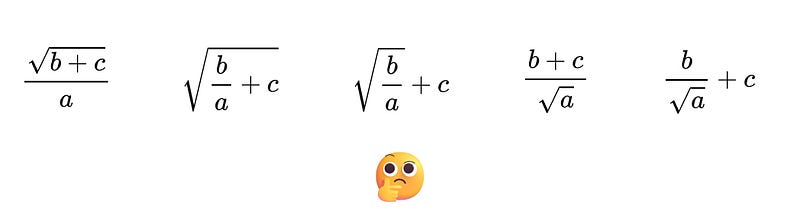 “B divided by the square root of a plus c” could be interpreted in five different equations, which leads to confusion for blind students.
How Access8Math is designed to enable accessible math learning
NVDA is an open-source platform that encourages community contributions to enhance its support for making the digital environment accessible. Access8Math is one such add-on and can be downloaded for free by anyone who needs this tool for learning math.
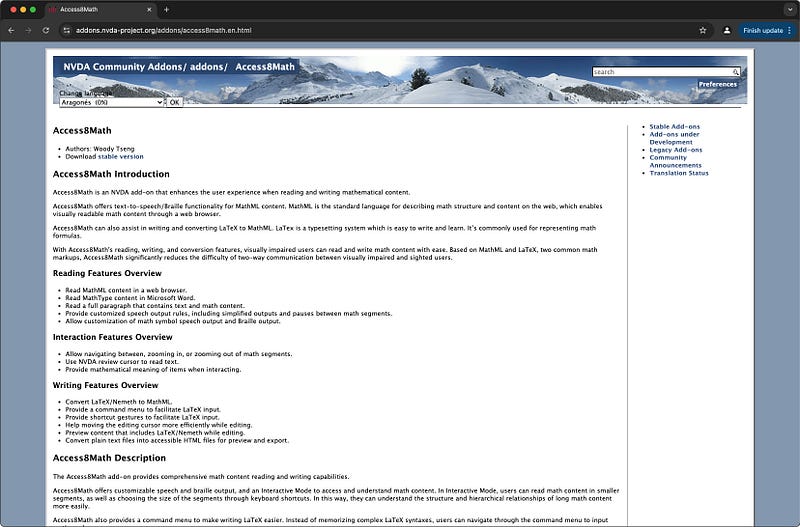 A add-ons website.An introduction to Access8Math and its details on the official NVDA add-ons website.
How Access8Math helps blind students learn math
Developed to address challenges in interpreting mathematical content, Access8Math enhances NVDA’s support for MathML. Its reading mode ensures more accurate interpretation of equations and symbols and includes features to optimize the reading experience. For example, it reads math content with pauses to make it easier to understand, and users can customize the pause duration based on their needs.
And its interaction mode enables users to zoom in and out of math segments with clear auditory feedback. When visually impaired students use NVDA to read equations, the content can often be lengthy and difficult to follow. With the Access8Math’s interactive feature, users can navigate equations using up/down and left/right arrow keys.
Below is an illustration of how users can navigate the equation ½ × ¾ using Access8Math in NVDA with keyboard controls.
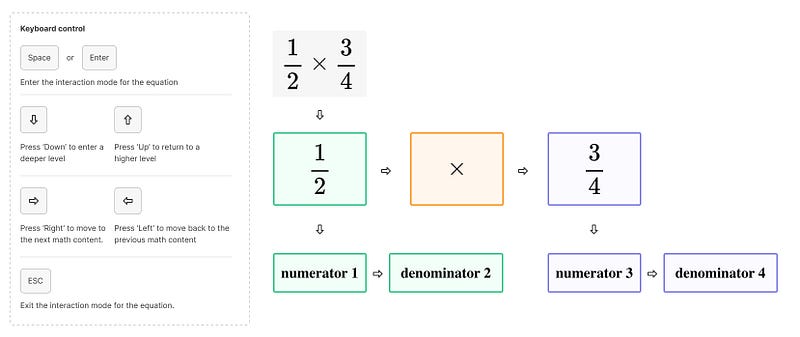 The main keyboard shortcuts for navigating equations in interaction mode, along with an example illustrating how blind users can navigate using Access8Math in NVDA.
How the Access8Math Web Editor helps teachers support learning
Apart from the challenges faced by students, another hurdle is teachers’ insufficient training in understanding the representation of math notations using digital tools, such as Nemeth braille and LaTeX, which are essential for screen readers to interpret math equations.
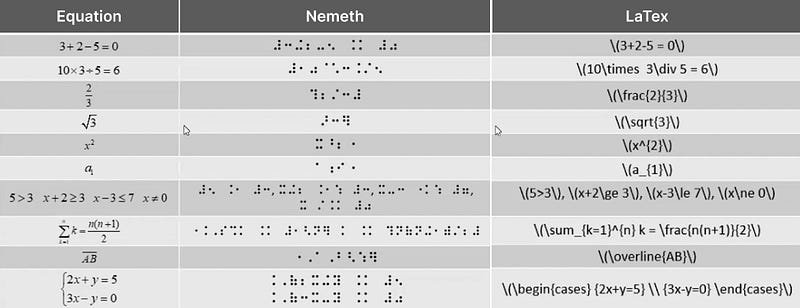 A side-by-side comparison of visual equations, Nemeth, and LaTeX. (source from the Access8Math tutorial)
To tackle this, Access8Math has offered a Web Editor that acts as a two-way translator, converting complex mathematical content into easy-to-understand equations for both students with visual impairments and teachers. Teachers can create math tasks that are readable by NVDA using the Access8Math Web Editor and export the content to share with visually impaired students. Once teachers receive the tasks from the students, they can then import and review students’ homework without needing to decode the content.
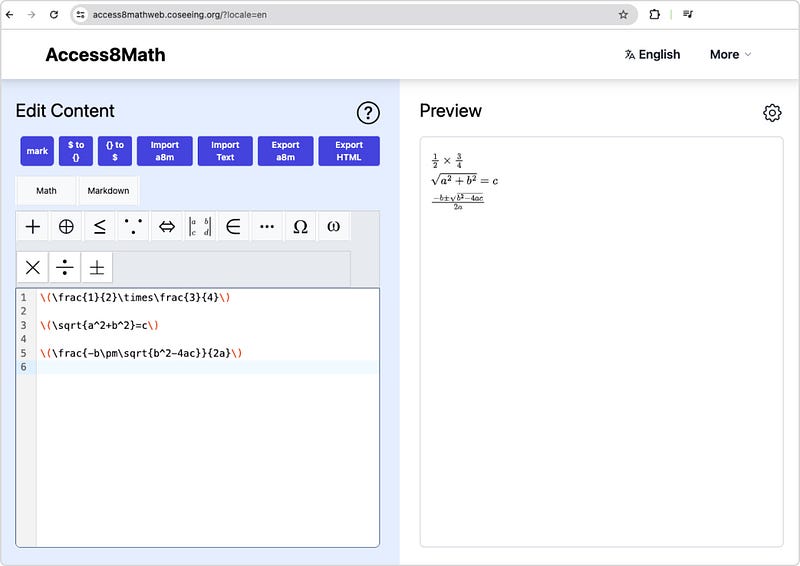 The Access8Math Web Editor is designed for teachers who need to create math content for visually impaired or blind students and review their tasks.
Advocating accessibility in digital environments through a community-driven approach
Behind Access8Math is Coseeing, a nonprofit community based in Taiwan, made up of individuals who believe that accessibility shouldn’t be a choice. They contribute their skills to develop this add-on in their spare time, with the goal of making the digital environment accessible and inclusive.
Woody, one of the key members of Coseeing and a visually impaired developer, shared that his motivation for creating Access8Math arose from a long-standing interest in math since school. With his visual impairment, he realized how unsupportive the learning environment was for visually impaired users and how many students missed the opportunity to experience the fun that math could bring.
Thus, Access8Math was created to break down these barriers and enable more students to explore math in schools. Since its launch, it has been used by many schools in Taiwan, where it’s originally created. One of the feedback from a physics student who became visually impaired during high school due to an accident and had to rely on NVDA to continue his studies. He expressed that thanks to Access8Math, he was able to continue learning math and science.
Built with inclusivity in mind: empowering users through accessible design and technology
We believe that learning should be inclusive for all, especially for students who need accessibility support in math. By understanding their needs and challenges, we developed an effective solution that empowers students with visual impairments to fully engage with and explore math throughout their learning process. For teachers, the Web Editor reduces barriers to instruction and makes learning more accessible for visually impaired students.
Access8Math has begun to gain attention in more countries as a tool for accessible education. Feel free to share this resource with anyone who might benefit, particularly those interested in exploring math but facing challenges due to a lack of accessible learning materials. We believe Access8Math will help students with visual impairments discover the joy of math and build their understanding and confidence.
For information on how to use Access8Math and NVDA, please refer to the following resources or reach out to us at coseeing@coseeing.org with any questions or ideas.
- Access8Math add on — how-tos documentation and download https://addons.nvda-project.org/addons/access8math.en.html
- Access8Math Web Editor https://access8mathweb.coseeing.org/?locale=en
- NVDA official website https://www.nvaccess.org/
- NVDA tutorial on navigating digital content in Window — A 9-minute YouTube video