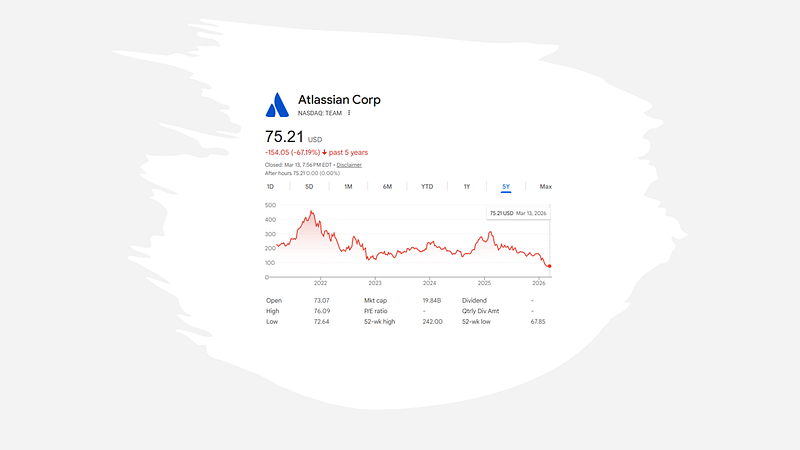
 Nasdaq: TEAM 3/13/2026
The rapid rise of AI is beginning to expose structural weaknesses in many of the systems engineering teams rely on.
For more than a decade Atlassian has been the default infrastructure for engineering organizations.
Jira served as the center of planning and execution, Confluence as a documentation layer, and Bitbucket handled source control for many organizations. Together they formed something powerful — an ecosystem that embedded itself into the operational DNA of engineering teams.
Once a company adopted Atlassian tools, they rarely replaced them. The system expanded, workflows multiplied, plugins were added, consultants were hired, and before long the entire engineering organization was deeply dependent on it.
For years, even with growing competition, that dominance felt permanent.
But lately the market signals suggest something is changing.
Recent layoffs impacting roughly 10% of Atlassian’s workforce as the company pivots toward AI and enterprise strategy are one example. Layoffs alone are not unusual in tech, but moves at that scale rarely happen when everything is operating perfectly. Companies restructure when they need to reposition.
The bigger question leaders should ask is not whether Atlassian will survive. Atlassian is a massive company with a large installed base and billions in revenue. The real question is whether Atlassian remains the platform that will define the next decade of software delivery.
In light of the rapid AI-driven evolution of the industry, the environment Atlassian originally thrived in is rapidly disappearing. Can it still maintain its leadership position? Is Atlassian still the long-term platform companies can rely on? Or is it time to change?
Growth by Acquisition, Not Innovation
Atlassian’s financial picture tells an interesting story.
Despite revenue growing from under $500M in 2016 to more than $4B today, profitability has remained thin and at times negative at the EBITDA level. One reason is the company’s heavy reliance on acquisitions to expand the platform rather than evolving a cohesive product internally.
Over the years Atlassian spent billions assembling its ecosystem through purchases. Products such as Trello ($425M), Opsgenie ($295M), Jira Align ($166M), and Loom ($975M) were folded into the Jira ecosystem to expand the company’s reach into work management, incident response, enterprise planning, and collaboration.
More recently Atlassian doubled down on this strategy with roughly $1B spent acquiring DX, a developer productivity analytics platform, and about $610M acquiring The Browser Company, the team behind the Arc and Dia browsers, in an attempt to move deeper into AI-driven development workflows.
The problem is that this approach creates an ecosystem that grows wider but not necessarily more coherent. Products arrive with bold positioning, only to be repositioned later or quietly deprioritized. Over time, users feel the impact. Integrations that were supposed to strengthen the platform often disrupt the products teams originally loved using.
Trello, for example, once promoted as a major pillar of Atlassian’s work management strategy, has seen its momentum fade. Loom, acquired to transform asynchronous collaboration, has yet to become a central part of the platform. Jira Align, once positioned as the enterprise planning layer for Jira, has gradually shifted as Atlassian pushes more planning capabilities back into Jira itself.
None of this is unusual for large platforms. But taken together it reveals a pattern. Atlassian’s growth has often come from assembling products rather than innovating a unified operating model for modern software organizations. And as software delivery begins shifting toward AI-driven development, autonomous agents, and integrated execution systems, the question many leaders are starting to ask is whether a platform built primarily through acquisitions can evolve fast enough for what comes next.
The End of Atlassian Server Was a Wake-Up Call
Another signal that shook many organizations was Atlassian’s decision to end support for its Server products and push customers toward cloud or Data Center editions.
For organizations operating in regulated industries, financial services, healthcare, defense, or companies with strict security policies, this was not a small change. Many had built their internal engineering infrastructure and complex workflow automations around Atlassian Server with the assumption that it would remain a long-term option.
Instead they were forced into difficult choices: migrate to Atlassian Cloud, move to the significantly more expensive Data Center model, or begin evaluating alternatives.
For some companies the migration was manageable. For others it became a multi-year effort involving plugin compatibility problems, integration breakage, and complex data migrations. In some cases entire engineering platform teams had to be assembled just to handle the transition.
The message many customers heard was simple: the vendor had changed the rules of the platform they depended on. And that experience caused many engineering leaders to quietly start asking a question they had not asked before.
How dependent are we on Atlassian?
The Growing Risk of the Atlassian Ecosystem
Atlassian isn’t just a product company. It’s an entire economic ecosystem.
Over the past decade Atlassian built one of the largest partner ecosystems in enterprise software. The Atlassian Marketplace now includes 5,000+ apps from more than 1,000 vendors, generating over $4B in lifetime sales for partners. Entire companies exist because Jira exists. Engineering analytics platforms like Jellyfish, time tracking tools such as Tempo Timesheets, and test management systems like Xray Test Management all depend heavily on Jira as their core distribution platform.
For many of these vendors, Jira is not just an integration. It is the business model.
The ecosystem goes far beyond software plugins. Atlassian also cultivated a large professional services economy through its Solution Partner Program. Consulting firms specialize in Jira implementations, workflow design, migrations, and enterprise rollouts. In large organizations Jira often requires dedicated administrators and configuration specialists to manage the growing system.
For many consultancies, Jira implementation and administration represent a significant portion of their revenue.
This ecosystem creates enormous gravitational pull around the platform. When a company adopts Jira, it rarely adopts Jira alone. It adopts a growing stack of plugins, analytics tools, integrations, and consulting services that accumulate over time.
That model comes with a cost. Many capabilities organizations would expect to be part of the platform like advanced reporting, time tracking, test management, portfolio planning, roadmap visualization, or developer analytics are often purchased a la carte through marketplace apps. Over time companies end up running a patchwork stack of add-ons layered on top of Jira, each with its own licensing model, upgrades, and integration points. The result is a system where the total cost of ownership can grow far beyond the base Jira license.
This dynamic also creates an interesting tension for Atlassian itself. Because thousands of vendors depend on the marketplace for revenue, building more native capabilities inside Jira risks disrupting its own ecosystem partners. In other words, Atlassian’s ability to innovate directly in the platform can sometimes collide with the economic incentives of the ecosystem built around it.
Technology history has shown how fragile platform ecosystems can be. When Adobe Flash was deprecated, an entire development ecosystem disappeared with it. When Google Glass faded, startups built around the platform vanished almost overnight.
The Atlassian ecosystem is far larger than those examples. But the principle remains the same: when thousands of businesses build their products, services, and careers around a single platform, its strategic direction becomes a risk factor for everyone in that ecosystem.
And if cracks are beginning to appear in Atlassian’s platform strategy, leaders should not only evaluate their dependency on Atlassian itself. They should also consider their dependency on the entire ecosystem that exists on top of Jira.
The World Atlassian Was Built For is Rapidly Changing
The Atlassian stack was designed for an era where the central challenge of engineering teams was organizing work.
Scrum boards, issues, workflows, and ticket management became the core abstraction for managing delivery. Teams broke down work into stories, moved them across boards, and measured progress using constructs like velocity and burndown charts.
In that world Jira made perfect sense. Relatively easy to get started and flexible enough to adapt to the way organizations preferred to work.
The problem is that modern engineering organizations have learned something important over the last decade: the hardest problems in software delivery rarely come from tracking tasks. They come from coordination across teams, architectural dependencies, shifting priorities, and the constant discovery of work that was never visible in the plan to begin with.
Tickets track activity. They do not necessarily track progress.
This distinction becomes painfully obvious as organizations scale. Somewhere between twenty five and two hundred engineers the system starts to fragment. Each team configures Jira differently. Workflows diverge. Metrics become incomparable. Moving engineers between teams becomes harder because each team effectively operates its own micro-process.
At that point Jira stops being a tool and starts behaving more like infrastructure. The irony is that most organizations never intended for this to happen. They adapted Jira to fit their teams, then adapted it again and again. After a few years the system becomes so deeply embedded that changing it feels impossible.
This created a powerful mousetrap. The stickiness generates enormous inertia, which is one of the main reasons Atlassian has remained dominant for so long. But the emergence of AI is starting to expose how fragile this model actually is.
The AI Moment Is Exposing Structural Limitations
Jira was designed to be infinitely configurable so every team could adapt it to their own process.
Atlassian’s entire economic model makes money from managing Jira complexity. Not just product complexity, but organizational complexity. The ecosystem works only because it’s genuinely and maybe even purposefully messy.
That flexibility helped Atlassian dominate the Agile era. And the AI era moves the industry in the opposite direction. AI thrives in environments where systems are structured, standardized, and produce predictable signals. The two forces are structurally opposed.
Most Jira environments have none of those characteristics.
Every organization configures Jira differently. Every team defines workflows differently. Even basic metrics often mean different things from team to team. AI systems operating in that environment are forced to interpret “apples and oranges” before they can generate insight.
In environments built on heavy customization, AI has the potential to disrupt entire software ecosystems that depend on that complexity. Not just Atlassian, but companies like Salesforce, ServiceNow, SAP, and Workday.
Then, there is the challenge with data fragmentation.
In many organizations the information needed to understand software delivery is spread across multiple tools and systems connected to the platform. The data required to understand execution is distributed, inconsistent, and often only partially visible from any single place.
This creates a structural limitation for AI systems. As environments become more customized and fragmented, the signals required to analyze execution become harder to correlate and interpret reliably.
And that is where the opportunity for a new generation of platforms begins to emerge. Systems designed with consistent structures and unified data models give AI something Jira environments often cannot — a clear view of execution.
A Different Future for Engineering Platforms
The next generation of engineering platforms will likely look very different from the systems built during the early Agile era.
Instead of focusing primarily on tickets, these systems will focus on execution signals. They will analyze how work flows through the organization, detect patterns across teams, surface risks before schedules slip, and provide leaders with a clear picture of what is actually happening inside the delivery system.
In other words, the platform will not just track work. It will understand delivery.
This shift becomes even more important as AI coding assistants accelerate development speed. When code generation becomes easier, organizational problems become the new bottleneck. Teams can produce code faster than ever, yet coordination across teams becomes even harder.
Visibility into delivery becomes more important, not less.
The platforms that succeed in this environment will likely be the ones that provide a strong operational model out of the box rather than expecting every organization to design its own.
A system where teams share a common structure. Where execution signals are consistent across the organization. Where AI can actually analyze delivery instead of trying to interpret wildly different signals.
Nobody Got Fired for Buying Jira
For many companies Atlassian was the safe choice. It became the IBM of the Agile era. Nobody got criticized for choosing Jira. It was the standard, the default, the tool everyone used.
But the software industry is entering a different phase.
AI is reshaping how software is written. Engineering organizations are becoming larger and more complex. Delivery visibility is becoming more important than ticket management.
And ecosystems that once looked permanent are beginning to show cracks.
None of this means Atlassian is going away. The company will likely remain a major player for years to come. But it does mean engineering leaders should start thinking carefully about how much of their operational model is tied to the Atlassian ecosystem.
The new generation of engineers and product teams is gravitating toward tools that are simpler, faster, and far more opinionated. And, in the world where AI dramatically accelerates software development, competitors can build and ship focused experiences much faster than before, putting pressure on large platforms that grew by continuously adding more features rather than simplifying the core experience.
The tools organizations choose today will shape how their delivery systems operate for the next decade.
And the systems that defined the last decade may not be the ones that define the next.
About the Author Alex Polyakov is the founder of Project Simple and a longtime builder of software products and engineering systems. With more than 25 years in the industry, he writes about software delivery, the evolution of engineering operating models, and how AI is reshaping the way teams build and deliver software.
If you enjoyed this article, feel free to follow for future writing on software delivery, engineering leadership, and AI.